
NB-IoT vs LoRaWAN: which to use for industrial IoT applications?
May 28, 2026Low Power Wide Area Networks (LPWAN) have become a foundational layer of Industrial IoT (IIoT), enabling large-scale connectivity for sensors and distributed assets with minimal power consumption. Among LPWAN technologies, NB-IoT and LoRaWAN dominate industrial deployments, but they address fundamentally different architectural and operational requirements. The decision between them is not about “which is better” in general. It is about matching network characteristics to deployment constraints – coverage availability, infrastructure control, cost model, device density, latency tolerance, and environmental conditions.
Below is a technical comparison focused on real-world industrial deployment scenarios.
How NB-IoT and LoRaWAN work in industrial IoT architectures
NB-IoT and LoRaWAN differ in their architectural design, which directly impacts scalability, control, and operational costs.
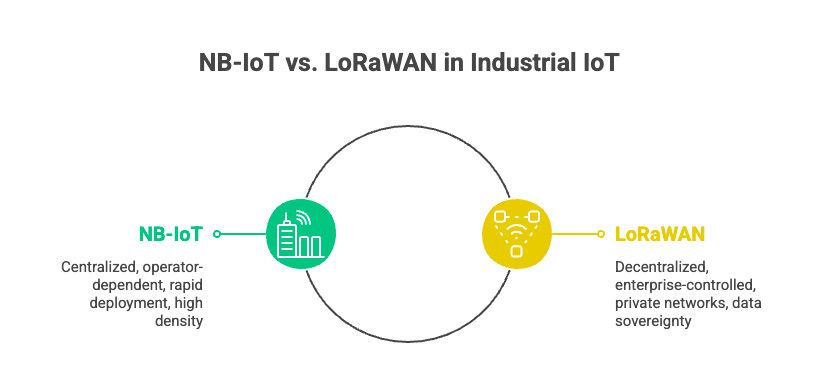
NB-IoT is a cellular LPWAN technology standardized by 3GPP. It operates on licensed spectrum and is deployed through existing mobile network infrastructure. Devices connect to operator-managed base stations, similar to LTE or 5G, but optimized for low data rates and power consumption. This enables rapid deployment in regions with established cellular coverage and supports up to 50,000 devices per cell, making it suitable for high-density deployments. From an IoT architecture perspective, NB-IoT is inherently centralized and operator-dependent. Device provisioning, connectivity, and quality of service are managed by telecom providers. This reduces infrastructure complexity for the end user but introduces ongoing operational costs and dependency on external networks.
LoRaWAN, in contrast, operates in unlicensed spectrum (typically 868/915 MHz) and uses a star-of-stars topology. End devices communicate with gateways, which forward data to a network server. This architecture enables organizations to deploy private IoT networks without relying on telecom operators. LoRaWAN deployments can be fully controlled by the enterprise – including gateway placement, network configuration, and data routing. This is particularly valuable in industrial environments where network independence, customization, and data sovereignty are critical.
NB-IoT vs LoRaWAN: technical comparison
| Feature | NB-IoT | LoRaWAN |
|---|---|---|
| Spectrum | Licensed (cellular) | Unlicensed (868/915 MHz) |
| Range | 1–10 km | 5–15 km |
| Power Consumption | Low (10+ years battery) | Very low (15+ years) |
| Data Rate / Latency | Higher rate, lower latency | Lower rate, higher latency |
| Security | 256-bit (3GPP standard) | AES-128 (dual-layer encryption) |
| Scalability | Millions per network, operator-managed | Flexible, network-dependent |
| Cost | Subscription (SIM, operator fees) | No subscription, gateway CAPEX |
| Interference Resistance | Moderate in industrial environments | High (CSS modulation) |
| Coverage Dependency | Requires cellular coverage | Independent, self-deployable |
The table highlights that the technologies are not direct substitutes; they optimize for different constraints.
- NB-IoT provides predictable performance, driven by licensed spectrum and operator-managed infrastructure. It offers lower latency and more consistent QoS, which is critical for applications that require reliable data delivery within defined time windows.
- LoRaWAN prioritizes efficiency and independence. Its ultra-low power consumption (often exceeding 15 years of battery life) and ability to operate without subscriptions make it ideal for long-term deployments with limited maintenance access.
The most important distinction lies in cost structure and control: NB-IoT shifts costs to OPEX (connectivity subscriptions), while LoRaWAN shifts costs to CAPEX (gateway deployment). This affects not only budgeting but also network planning, maintenance strategy, and scalability models.
Performance in industrial environments: coverage, interference, and reliability
Industrial environments introduce constraints that are rarely captured in specification sheets. Signal propagation, interference, and infrastructure availability define actual performance.
Coverage behavior differs significantly
NB-IoT benefits from cellular infrastructure with strong indoor penetration, especially in urban or semi-urban environments. It performs well in smart factories with existing cellular coverage, utility metering in buildings, and urban infrastructure monitoring. However, NB-IoT coverage is entirely dependent on operator networks. In remote areas, coverage gaps can limit deployment feasibility or require external solutions.
LoRaWAN, by contrast, provides coverage independence. Gateways can be deployed strategically to cover industrial campuses, remote facilities, and linear infrastructure (pipelines, railways). With a typical range of 5–15 km, LoRaWAN can cover large areas with minimal infrastructure, especially in rural or open environments.
Interference handling is another key differentiator
LoRaWAN uses Chirp Spread Spectrum (CSS) modulation, which provides strong resistance to interference and multipath effects. This makes it particularly effective in metal-heavy industrial facilities, high electromagnetic interference environments, and underground or semi-enclosed spaces. NB-IoT, while stable in controlled environments, may experience performance degradation in interference-heavy industrial settings due to its reliance on cellular spectrum conditions.
Latency and reliability trade-offs must also be considered
NB-IoT offers lower latency and more deterministic IoT device communication, making it suitable for:
- Frequent telemetry updates;
- Time-sensitive monitoring;
- Certain control scenarios (within LPWAN limits).
LoRaWAN operates under higher latency and duty-cycle constraints, which limit its suitability for real-time control. However, it remains highly reliable for:
- Periodic telemetry;
- Event-driven alerts;
- Low-frequency data transmission.
Industrial use cases: where each technology fits
NB-IoT is well-suited for structured, high-density environments with reliable cellular coverage. Typical use cases include:
- Smart metering (electricity, water, gas) in urban areas;
- Asset tracking across logistics networks;
- Connected infrastructure, such as street lighting or parking systems;
- Manufacturing environments with cellular coverage to ensure consistent connectivity.
These deployments benefit from centralized network management, predictable quality of service, and scalability across thousands or millions of devices
LoRaWAN excels in remote, distributed, or harsh industrial environments. Typical use cases include:
- Oil and gas fields with geographically dispersed assets;
- Mining operations where infrastructure is limited;
- Utility monitoring across rural or regional networks;
- Industrial facilities with high RF interference.
These scenarios prioritize long battery life (15+ years), minimal maintenance, independence from telecom infrastructure, and robust performance under challenging conditions.
Conclusion
NB-IoT and LoRaWAN are not competing technologies in the traditional sense. They represent two distinct approaches to LPWAN connectivity. LoRaWAN is the default choice for remote, interference-heavy, and cost-sensitive deployments, where control and battery life are critical. NB-IoT is better suited for urban, large-scale, and latency-sensitive applications, where operator-managed infrastructure provides stability and scalability. For industrial IoT architects, the key is not choosing one over the other globally, but mapping each technology to the right layer of the system architecture.