
Cloud Medical Device Platform
A validatable IoT backend for connected medical device software
For a connected medical device, the backend is not just a place where telemetry lands. It becomes part of the technical evidence story around 510(k), software documentation, cybersecurity review, validation, service operations, and post-market support.
Talk to our engineersA controlled platform layer for 510(k)-oriented validation
KaaIoT provides the connected-device platform layer. It helps teams connect devices, collect telemetry, manage device metadata, configure dashboards, create alerts, run rule-based workflows, support controlled remote operations, expose APIs, and integrate device data with external systems.
For medical device projects, KaaIoT can also be delivered with a Validation Bundle. The Validation Bundle organizes the platform setup into a project-specific technical package: architecture description, data-flow description, device metadata structure, firmware and configuration evidence, cybersecurity evidence, platform SBOM, dashboard templates, export formats, integration mapping, and evidence handoff.
The goal is not to replace the manufacturer’s QMS, regulatory strategy, or 510(k) responsibility.
The goal is simpler and more practical: give medical device teams a connected-device platform that is controlled, explainable, auditable, and ready to support 510(k)-oriented validation and cybersecurity evidence.
This matters because FDA’s software guidance describes recommended documentation for premarket submissions for device software functions, and FDA’s February 2026 cybersecurity guidance covers cybersecurity device design, labeling, and documentation FDA recommends for premarket submissions for devices with cybersecurity risk.
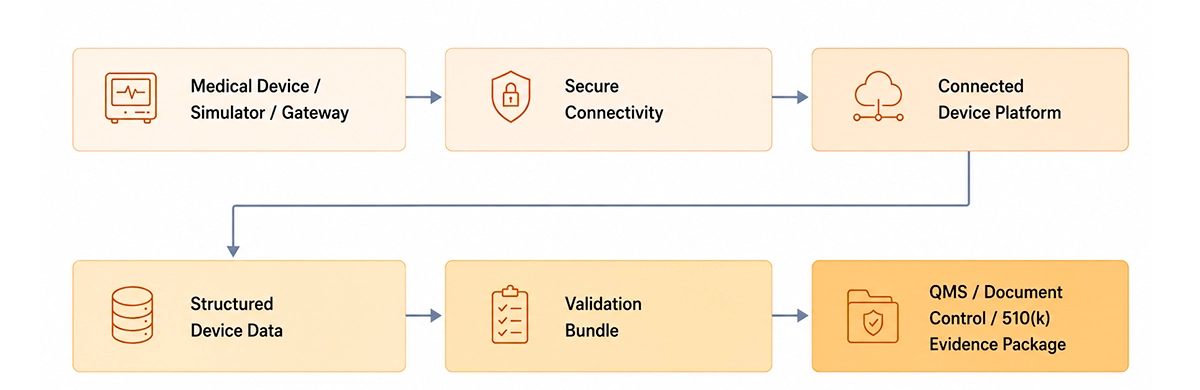
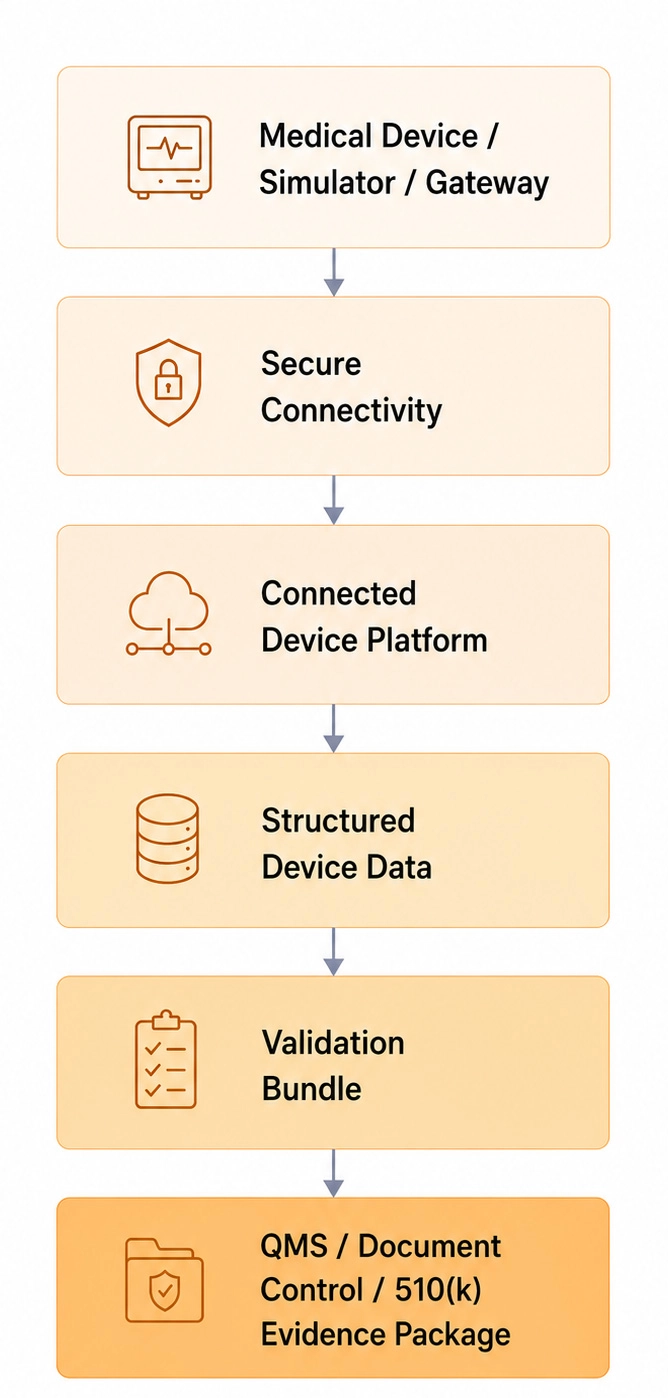
A 510(k)-oriented platform workflow
Core platform requirements for 510(k) evidence
The platform is more than a data receiver. It supports connected-device architecture, 510(k) evidence workflows, device communication, telemetry, remote operations, cybersecurity visibility, and evidence handoff.
At minimum, the platform requirements should cover the following areas.
Device Identity and Inventory
Before the platform can collect useful data, it must know which device is connected, what firmware it uses, which configuration is active, where it is deployed, and what lifecycle status it has.
Without this context, device data becomes hard to trust, compare, reproduce, or include in a 510(k) evidence package.
Telemetry by itself is not evidence. A temperature value, alarm, error, command response, or connectivity event becomes useful for 510(k) validation only when it is linked to a clear device context.
The team should be able to answer:
Secure Connectivity
For a connected medical device, the platform must clearly define how each device, simulator, gateway, or lab setup connects, sends data, and handles communication failures.
Secure connectivity turns “the device sends data” into a controlled data flow that can support 510(k)-oriented validation and cybersecurity review.
A controlled connectivity model should make it clear how the device authenticates, which protocol is used, whether communication is encrypted, what payloads are sent, and how failures are handled across lab, validation, pilot, and production environments.
The team should be able to answer:
Telemetry and Event Collection
Telemetry captures the device’s ongoing state, while events mark specific changes, alarms, errors, commands, updates, and connectivity shifts during the test window.
Scattered screenshots, logs, and CSV files are not validation evidence.
For 510(k)-oriented validation, telemetry and events need to be structured, timestamped, and tied back to the exact device, firmware, configuration, and test run.
The team should be able to answer:
Configuration and Firmware Tracking
Connected medical device behavior can depend on firmware, configuration, parameter changes, feature flags, calibration settings, and environment-specific conditions.
For 510(k) evidence, untracked firmware or configuration changes can make test results difficult to defend.
Tracking this history makes device behavior reproducible, comparable, and reviewable across telemetry, test runs, alarms, and reported issues.
The platform should track:
Commands and Remote Operations
Commands define which actions the platform can execute toward a device, gateway, simulator, or lab setup, including operations that may change behavior or state.
A 510(k)-ready platform must treat commands as controlled actions, not informal support shortcuts.
Because remote actions can affect safety, cybersecurity, validation, service workflows, or data integrity, each operation needs defined permissions, execution rules, status handling, and a complete audit trail.
The platform should support controlled command execution:
For each command, the team should define a risk profile:
Dashboards and Reports
Dashboards and reports define how device data is reviewed, understood, shared, and reused across operations, validation, and quality workflows.
For 510(k) evidence, reports must package device behavior, metadata, deviations, and data completeness into reviewable output.
A dashboard should help users make a decision, not overwhelm them with raw data. Reports should package the same information in a format that can be reviewed, shared, exported, or attached to validation and quality workflows.
A good dashboard should answer specific questions:
For 510(k) evidence, reports may include:
Access Control and Auditability
Access control defines who can use the platform, what they can see, and which actions they can perform, while auditability records what actually happened.
For 510(k) evidence, cybersecurity review depends on proving that sensitive actions were authorized, visible, and traceable.
Users may view device data, change configurations, execute commands, open remote access sessions, manage firmware updates, export reports, or modify alert rules, and all of these actions must be controlled and visible.
The platform should support:
Audit logs should capture:
Integrations and Evidence Handoff
The platform may collect telemetry, alarms, events, firmware versions, configuration changes, command history, remote access activity, and audit logs, but that data still needs to flow into the systems where teams validate, investigate, document, and release.
Handoff for 510(k) evidence must preserve what was collected, where it came from, and how it supports the submission workflow.
Evidence handoff should be structured and reusable, not built from screenshots, manual notes, or disconnected CSV files copied from dashboards into documents.
The team should be able to answer:
Cybersecurity, SBOM, and FDA Expectations
Cybersecurity is not an optional feature for a connected medical device platform.
FDA’s February 2026 final guidance addresses cybersecurity device design, labeling, and premarket submission documentation for devices with cybersecurity risk, including cyber devices under Section 524B of the FD&C Act.
For a connected medical device platform, this changes the conversation.

What cybersecurity actually covers
Cybersecurity is not only about TLS, passwords, or network protection. It covers the full connected-device lifecycle:
Cybersecurity evidence the platform helps produce
For 510(k)-oriented projects, the platform should help the team produce cybersecurity evidence that is understandable, reviewable, and connected to the actual implementation. This evidence may include:

Platform SBOM
As part of the KaaIoT Validation Bundle, KaaIoT provides an SBOM for the platform components delivered in the project, giving the customer visibility into the connected-device platform layer, including platform version, component inventory, component versions, known vulnerability status, and remediation or mitigation evidence within the KaaIoT platform scope. The SBOM should be maintained as a living validation artifact, not treated as a static spreadsheet created once and forgotten.
For connected medical device projects, SBOM should be connected to:
KaaIoT provides the connected-device platform, platform SBOM, cybersecurity visibility, auditability, and evidence structure for the platform layer. The manufacturer remains responsible for the medical device, product-specific software, regulatory strategy, and 510(k) submission.
Platform risk controls
After requirements are defined, the team should identify platform-level risks and controls.
These risks are not limited to commands. They can come from onboarding, connectivity, data collection, configuration changes, firmware updates, dashboards, remote access, integrations, exports, cybersecurity events, user access, or unclear UI.
Platform-level risk review should cover:
Map requirements to KaaIoT platform capabilities
After the platform requirements and platform-level risks are defined, the next task is to map them to KaaIoT platform capabilities.
How this mapping works
This mapping is not a simple feature checklist. It shows how connected medical device platform requirements become configured KaaIoT capabilities, implementation mechanisms, and exportable evidence.
KaaIoT provides the core platform building blocks out of the box, including device registry, provisioning, secure connectivity, telemetry ingestion, metadata, configuration management, commands, alerts, dashboards, reports, APIs, integrations, access control, auditability, deployment options, platform SBOM, and engineering support.
The result is a configured connected medical device platform, not a blank IoT system the customer must figure out alone.
KaaIoT engineers configure these capabilities for the specific customer project, so generic platform features become the right data model, metadata structure, telemetry flow, event logic, command rules, dashboard views, reports, integrations, and evidence handoff process.
For example, device metadata can be shaped around the medical device workflow: device model, firmware version, hardware revision, configuration version, device batch, environment, lifecycle status, test-run context, and validation relevance.
The Validation Bundle documents the implementation and packages the evidence structure with technical documentation, platform SBOM, cybersecurity evidence, validation-support materials, and engineering support.

Cybersecurity and SBOM mapping
Cybersecurity maps across the whole connected-device platform: onboarding, authentication, secure communication, user access, commands, firmware updates, APIs, audit logs, integrations, vulnerability management, and evidence exports.
As part of the Validation Bundle, KaaIoT provides an SBOM for the platform components delivered in the project, including component inventory, versions, vulnerability status, and remediation or mitigation evidence within KaaIoT scope.
KaaIoT documents the platform layer; the manufacturer remains responsible for product-specific medical device software and firmware unless included in the project scope.
The Validation Bundle can include platform release information, software component inventory, known vulnerability summary, security-control summary, deployment security description, access-control matrix, audit log examples, API and integration security notes, and cybersecurity evidence export structure.
If SBOM coverage is needed for device firmware, gateway firmware, mobile apps, or other customer-controlled software, that scope should be defined separately or provided by the customer’s engineering process.
This keeps the cybersecurity boundary clear: KaaIoT provides SBOM and evidence for the connected-platform layer, while the manufacturer owns the product-specific components outside that scope.
Remote operations mapping
Remote operations must be mapped carefully because they can affect device behavior, data collection, service workflows, or the test environment.
For medical device projects, every command should have a defined purpose, target device or group, allowed environment, user roles, risk level, approval rules, execution history, response tracking, audit trail, and validation status.
The Validation Bundle should show which remote actions exist, how they are controlled, and what evidence is recorded when they are used.
The command catalog and command risk matrix help separate routine service actions from higher-risk operations that may require stronger authorization or validation before use.
This matters most for actions that can change device state, configuration, firmware, alarm behavior, data collection, connectivity, or service mode.
Each operation should leave a clear record of who initiated it, where it was allowed, what happened, and whether the device responded as expected.

Implementation
After this mapping, the customer has a clear implementation baseline: which requirements are covered by KaaIoT, which capabilities need project configuration, and which workflows require integration with customer systems.
The team can also see which cybersecurity, SBOM, and vulnerability evidence is provided for the platform layer, which artifacts are included in the Validation Bundle, and which responsibilities remain with the manufacturer.
The customer starts from existing KaaIoT capabilities, engineering support, and a 510(k)-oriented evidence workflow.
This creates a practical bridge between requirements and implementation, so the connected-device platform is organized around controlled workflows, documented responsibilities, and reviewable outputs from the start.
Instead of designing a blank backend architecture, the project can begin with proven platform capabilities for device identity, connectivity, telemetry, configuration, commands, reports, integrations, access control, auditability, and evidence handoff.
KaaIoT engineers then configure these building blocks around the customer’s medical device workflow and package the relevant implementation evidence in the Validation Bundle.

Book 30-minute call for Connected Medical Device Backend Review
Bring your device roadmap and regulatory timeline. We’ll map the platform layer to your submission plan and show you the evidence it produces — no slideware.