What is a data logger and how it works in industrial IoT
June 16, 2026Data loggers are compact electronic devices that automatically measure and record data from sensors over time. They are widely used in industrial environments to monitor conditions such as temperature, humidity, pressure, and electrical parameters without requiring constant human supervision. In HVAC systems, manufacturing plants, logistics operations, and energy infrastructure, they provide a continuous record of what is happening in the field.
That continuous record is what makes data loggers so valuable. A single measurement can confirm that a system is operating normally at a specific moment, but it says little about how conditions change throughout the day or how equipment behaves under varying loads. By capturing timestamped data over days, weeks, or months, data loggers reveal trends, recurring inefficiencies, and early signs of failure that would otherwise remain hidden. In industrial IoT, this historical data becomes the foundation for analytics, automation, and operational optimization. The quality of any monitoring system ultimately depends on the quality and consistency of the data it collects, and that process often begins with a well-designed data logger.
What a data logger does
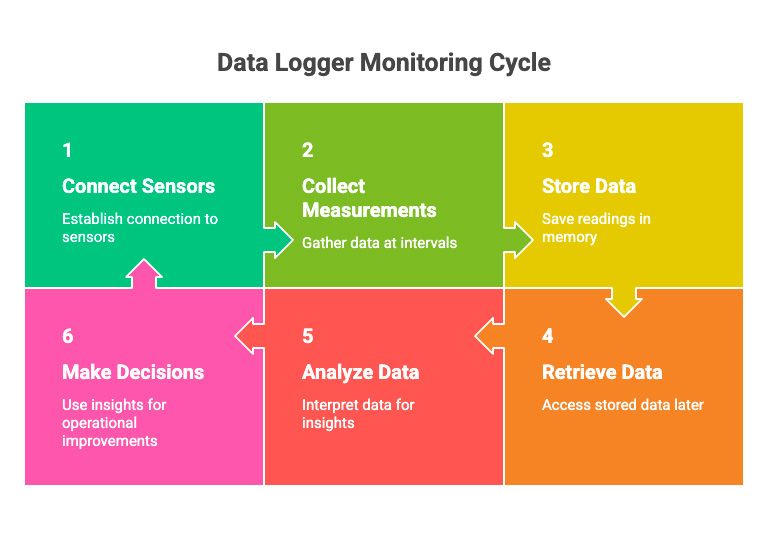
A data logger acts as a self-contained monitoring device: it connects to one or more sensors, collects measurements at predefined intervals, and stores those readings in internal memory for later retrieval or transmission to external systems. The types of measurements depend on the application. In building automation, a logger may track temperature, humidity, and CO₂ levels to evaluate HVAC performance. In manufacturing, it may record pressure, vibration, or voltage to detect process deviations. In solar and battery systems, it captures production, consumption, and storage metrics to help operators understand how energy assets are performing.
The value of a data logger lies in its ability to create a reliable timeline of system behavior. Instead of relying on periodic manual checks, operators can review precisely when conditions changed, how long deviations persisted, and whether a recurring pattern is developing. This information supports several important business and operational goals:
- Demonstrating compliance with regulatory or contractual requirements;
- Identifying inefficiencies and operational anomalies;
- Building historical datasets for predictive analytics.
Data loggers replace assumptions with evidence. They provide the data needed to diagnose issues accurately and make better operational decisions.
How data loggers work
Although data loggers vary in complexity, their operating principle is straightforward. Before deployment, the device is configured using software or a local interface. Users define what parameters to record, how often to capture measurements, and what thresholds should trigger alarms. Once the logger is activated, connected sensors measure physical conditions and convert them into electrical signals. The internal microprocessor digitizes those signals, applies calibration, and associates each value with a timestamp. The resulting records are stored in non-volatile memory, which preserves the data even if the device loses power.
Data can then be retrieved in several ways. Simpler devices may require a USB download after deployment. More advanced models transmit information continuously over Ethernet, Wi-Fi, cellular networks, or MQTT-based IoT infrastructure. This architecture allows data loggers to operate autonomously for extended periods, often in remote locations where direct supervision is impractical. As long as the device has power and available storage, it can continue collecting data with minimal maintenance.
Key components inside a data logger
Despite their compact form factor, data loggers combine several specialized components that work together to ensure accurate and reliable monitoring.
- Sensors measure physical variables such as temperature, humidity, current, or pressure. The quality and calibration of these sensors have a direct impact on data accuracy.
- A microprocessor serves as the device’s control center. It converts sensor signals into digital values, applies processing logic, and manages communication and storage functions.
- Non-volatile memory stores measurements locally, while a battery or external power supply enables uninterrupted operation in field conditions.
- Communication interfaces such as USB, RS-485, Ethernet, Wi-Fi, or cellular connectivity determine how data is transferred to users or integrated with other systems.
The combination of these elements allows a data logger to function as a durable, self-sufficient monitoring device capable of operating reliably in industrial environments.
Why data loggers matter in industrial IoT
Traditional data loggers were often used as isolated devices. Engineers deployed them, collected data for a period of time, and downloaded the results manually for analysis. That approach remains useful for temporary studies and validation projects, but it does not provide the real-time visibility that modern industrial operations increasingly require. In industrial IoT architectures, data loggers are connected to edge gateways and cloud platforms that make telemetry available as soon as it is generated. Instead of waiting until the end of a logging cycle, operators can view live dashboards, receive alerts, and trigger automated actions based on incoming data.
This changes the role of the data logger significantly. It becomes the first layer of a broader data pipeline that supports predictive maintenance, energy optimization, and operational automation. For example, an HVAC unit may appear to be functioning normally, while its supply air temperature gradually drifts outside the expected range. A connected data logger captures this trend and sends the data to an IoT platform, where rules can notify operators before the issue affects comfort or energy consumption. The same principle applies in manufacturing, logistics, and energy systems. Continuous data collection enables organizations to move from reactive troubleshooting to proactive management.
Data loggers in real-world applications
Data loggers are used across virtually every industry where environmental or process conditions affect performance, quality, or compliance. In commercial buildings, they help facility managers monitor temperature, humidity, occupancy, and power consumption. Historical data makes it easier to identify inefficient schedules, diagnose HVAC issues, and verify building performance. In manufacturing, data loggers capture process variables and machine conditions that influence product quality and equipment reliability. Engineers use this information to detect abnormal behavior before it leads to downtime. In cold chain and logistics operations, data loggers provide a documented record of temperature conditions during storage and transportation. This record is essential for demonstrating compliance and investigating potential product loss. In energy systems, they collect telemetry from inverters, battery storage systems, and electrical meters, giving operators a detailed view of production and consumption patterns.
From data logging to intelligent energy management
Basic data loggers are effective when the goal is simply to capture measurements. However, many industrial organizations eventually need more than stored data. They need centralized visibility, secure remote access, automated alerts, and the ability to act on telemetry in real time. This is where the KaaIoT Universal Energy Controller becomes particularly relevant.
The Universal Energy Controller (UEC) combines the essential functions of a data logger with the capabilities of an industrial edge gateway. It connects directly to energy assets, collects telemetry using standard industrial protocols, and securely transmits that data to cloud or on-premises systems. The device supports plug-and-play integration with many widely used inverter brands, including Deye, Solis, Growatt, GoodWe, and Huawei. It connects through standard DB9 or RJ45 ports using RS-485 or RS-232 interfaces, which simplifies deployment and avoids custom wiring.m Once connected, the UEC translates Modbus data into MQTT and transmits it over TLS-encrypted connections using unique authentication keys. Organizations can send data to the KaaIoT Cloud, a private managed environment, a self-hosted deployment, or any MQTT broker of their choice. This flexibility allows customers to maintain full ownership and control of their operational data.
The controller also supports capabilities that go far beyond traditional data logging, including automatic equipment discovery, real-time telemetry mapping, OTA firmware updates, time-series storage, custom dashboards, and rule-based automation. For example, if solar generation exceeds on-site demand, the system can automatically charge batteries or redirect excess energy to the grid according to predefined business logic. In this way, the Universal Energy Controller does not simply record energy data – it enables organizations to act on that data immediately. Built with a transparent US supply chain and aligned with FEOC requirements, the device is suitable for enterprise and government projects that impose strict procurement and security standards.
Conclusion
Data loggers are a foundational technology for industrial monitoring. As industrial systems become more connected, the role of the data logger continues to evolve. What was once a standalone recording device is now often part of a larger architecture that supports analytics, real-time alerts, and automated control. The KaaIoT Universal Energy Controller reflects this evolution. It combines robust data logging with secure connectivity, flexible deployment, and automation capabilities that help organizations monitor and optimize energy systems at scale. For companies looking to move beyond basic monitoring and build a more intelligent energy infrastructure, the KaaIoT Universal Energy Controller provides a practical and scalable starting point.