
Smells good? The role of AI and IoT in digital olfaction
March 30, 2026For decades, scent in commercial and public environments was treated as a passive enhancement. Diffusers operated on fixed schedules, controlled manually, and rarely integrated with any other building systems. There was neither telemetry, adaptive logic, nor visibility into performance or environmental impact. Scent functioned as a background aesthetic layer rather than an operational variable. But that model is now changing, provided that AI and IoT technologies mature. Digital scent systems evolve into connected, programmable components within broader smart infrastructure. Electronic noses, smart diffusers, and environmental sensors now generate and process data in real time. Instead of deploying fragrance blindly, operators measure, analyze, and orchestrate scent as part of a unified control strategy. In this context, scent becomes a controllable environmental parameter similar to temperature, lighting, or airflow. AI provides analytical intelligence, while IoT provides connectivity and centralized management. Let's take a look at how AI and IoT are driving the development of digital scent technology in 2026.
Market growth signals – digital scent is moving into infrastructure
The digital scent technology market reflects this structural transition. Valued at approximately USD 1.33-1.47 billion in 2025-2026, it is projected to reach USD 2.91-3.23 billion by 2032-2034, growing at an annual rate of 9-10%, according to Precedence Research data. This growth is steady, but adjacent AI-driven segments are expanding even faster. AI-powered digital scent devices and IoT-connected ambient diffusers show double-digit CAGRs, with some estimates approaching 20%.
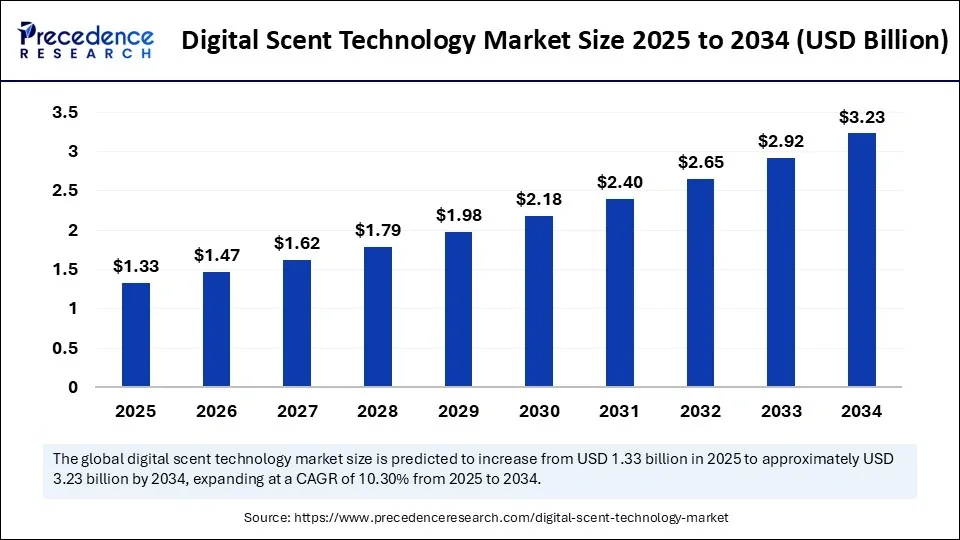
The faster expansion of AI- and IoT-enabled segments indicates that the market is not simply growing due to fragrance demand. It is growing because scent systems become connected assets within digital ecosystems. Integration with smart homes, commercial building automation, healthcare diagnostics, and industrial monitoring platforms is redefining the role of scent. Instead of functioning independently, scent systems increasingly depend on data exchange and real-time coordination with other technologies. This shift aligns with broader AIoT trends, in which environmental control systems are expected to operate as coordinated networks rather than as isolated devices.
AI as the intelligence layer from odor detection to predictive scent control
Artificial intelligence plays a central role in transforming digital scent technology from static output to an adaptive system. Electronic noses equipped with multi-sensor arrays detect volatile organic compounds (VOCs) and generate chemical signatures that represent specific odors. These signatures are processed using machine learning models trained to classify patterns, detect anomalies, and identify subtle variations that may indicate environmental change or risk. Compared to rule-based threshold detection, AI-driven systems improve through continuous exposure to environmental data. In healthcare environments, this capability supports breath analysis for early disease detection. Certain metabolic and infectious conditions produce identifiable VOC markers, and AI models can compare detected signatures against trained datasets to flag deviations. This enables non-invasive screening approaches that complement traditional diagnostics.
In commercial environments, AI shifts the focus from detection to control. Diffusion intensity can be adjusted dynamically based on occupancy density, airflow conditions, and historical usage patterns. Rather than releasing fragrance at predetermined intervals, predictive algorithms determine optimal timing and concentration to maintain consistency while reducing overuse. This approach not only enhances environmental stability but also reduces operational costs by preventing unnecessary diffusion cycles.
AI effectively converts scent delivery into a feedback-controlled system in which sensor inputs continuously inform actuator outputs.
IoT as the control plane that connects scent to smart ecosystems
While AI enables intelligence, IoT enables infrastructure. Smart diffusers and e-noses become connected endpoints that can transmit telemetry, receive configuration updates, and respond to centralized rules. This connectivity transforms scent devices into manageable IoT assets rather than standalone appliances. In large facilities or distributed commercial networks, centralized oversight is essential. Operators need visibility into device health, fragrance consumption, environmental readings, and system status across multiple sites. IoT connectivity makes this possible through secure data exchange over Wi-Fi, LoRaWAN, or cellular networks, depending on deployment requirements. Low-power sensor design ensures scalability without excessive energy consumption.
The true infrastructure shift occurs when scent systems integrate with broader building technologies. Coordination with HVAC systems allows diffusion intensity to adapt to airflow rates. Integration with occupancy sensors ensures scent activation aligns with real-time presence rather than static schedules. When linked to air quality monitoring, diffusion can automatically respond to environmental shifts. In this architecture, scent becomes a responsive actuator within a cyber-physical building system rather than an isolated enhancement feature.
Managing Digital Scent at Scale with KaaIoT
Managing dozens or hundreds of connected diffusers requires structured provisioning, real-time monitoring, and rule-based automation. Without a dedicated IoT platform, system complexity increases rapidly, limiting scalability and operational efficiency. KaaIoT provides an orchestration layer that enables centralized management of connected scent systems through configurable IoT dashboards, including its dedicated HVAC scenting system solution for building-integrated deployments. Instead of interacting with each device individually, operators gain a unified interface for monitoring and control. The platform supports secure device onboarding, telemetry visualization, and automated rules tied to environmental data streams.
Through centralized dashboards, organizations can maintain consistent diffusion policies across multiple locations while allowing local adjustments when necessary. Real-time data collection supports analytics on fragrance usage, device uptime, and environmental conditions. API-based integration enables scent systems to communicate with building management systems and other IoT subsystems. This architecture ensures that scent control operates as part of an integrated digital infrastructure rather than as a standalone solution. The value of such orchestration lies in standardization, scalability, and operational transparency, turning scent systems into measurable, auditable, and optimizable components of the smart building stack.
High-impact use cases across industries
Digital scent technology delivers the greatest value when embedded in structured AIoT environments. In healthcare, AI-enabled e-noses support non-invasive monitoring and environmental risk detection, providing early warning of infectious disease markers and airborne hazards. Centralized monitoring enables data from multiple facilities to be aggregated and analyzed systematically.
In commercial real estate and smart buildings, scent diffusion can align with occupancy patterns and HVAC cycles, creating adaptive environments that respond automatically to crowd density and ventilation shifts. Retail environments benefit from consistent ambient control across distributed locations, while corporate spaces use automated scent modulation to maintain a stable sense of comfort. These applications rely not on fragrance novelty but on predictable, data-driven environmental management.
Industrial and smart city environments extend the model further by leveraging connected odor-detection systems to identify chemical leaks or hazardous emissions in real time. Networked sensors provide centralized alerting and rapid response capabilities, integrating scent detection into broader environmental monitoring frameworks. Across these sectors, the operational value derives from connectivity and intelligence rather than from scent alone.
Conclusion
Digital scent technology is transitioning from aesthetic enhancement to an infrastructure component. AI enables continuous odor analysis, predictive control, and adaptive response to environmental inputs. IoT enables connectivity, remote configuration, and centralized orchestration across distributed deployments. Together, they transform scent into a measurable, programmable parameter in smart environments. As buildings and industrial systems become increasingly data-driven, scent joins temperature, airflow, and lighting as part of the controlled environmental stack. KaaIoT provides the necessary control plane to securely manage connected devices at scale. This architectural shift positions scent not as a marketing accessory, but as an integrated element of intelligent infrastructure. In 2026, smell is no longer subjective or static; it is monitored, analyzed, optimized, and governed through data.