
Is your inverter too big? Understanding the downsides of oversizing and how to detect them
December 10, 2025In building a first off-grid or hybrid solar system, one of the most common mistakes is choosing an inverter that is far larger than the actual battery and PV array can support. A typical beginner setup might look like this: a 10 kW inverter, a 5 kWh battery, and only 2 kW of solar panels. Configurations like this appear frequently, and they always raise the same question: Does an oversized inverter have any negative consequences?
At first glance, a more powerful inverter seems like a good idea: more headroom, better handling of peak loads, and “it’s always better to have more.” But in practice, a mismatch between inverter size, panel power, and battery capacity creates several hidden downsides that many system owners discover only after installation. Experienced off-grid users often notice that large inverters consume more energy on their own, especially during the night when there is no PV input.
Let’s break down why an “oversized inverter” isn’t always a problem, but can easily become a source of unnecessary losses.
What “oversized inverter” actually means
When people talk about an inverter being “too big,” they usually think only about the power rating printed on the label: 5 kW, 8 kW, 10 kW, and so on. But the nominal AC power is just one function of the device. A larger inverter has a larger chassis, more switching components, more cooling hardware, and, in general, more internal electronics that must remain powered on whenever the unit is active. This is why inverter size affects not only how much load you can run, but also how much energy the inverter consumes simply by being operational. This leads to a necessary clarification: an oversized inverter does not increase the real power of your solar system. It doesn’t increase the panels' electricity output, and it doesn’t increase the battery's usable capacity. If your array can produce only 2 kW, the inverter cannot turn that into 5, 8, or 10 kW, regardless of its rating. Likewise, if your battery can safely deliver only 2–3 kW of discharge, a 10 kW inverter won’t magically make it output 10 kW.
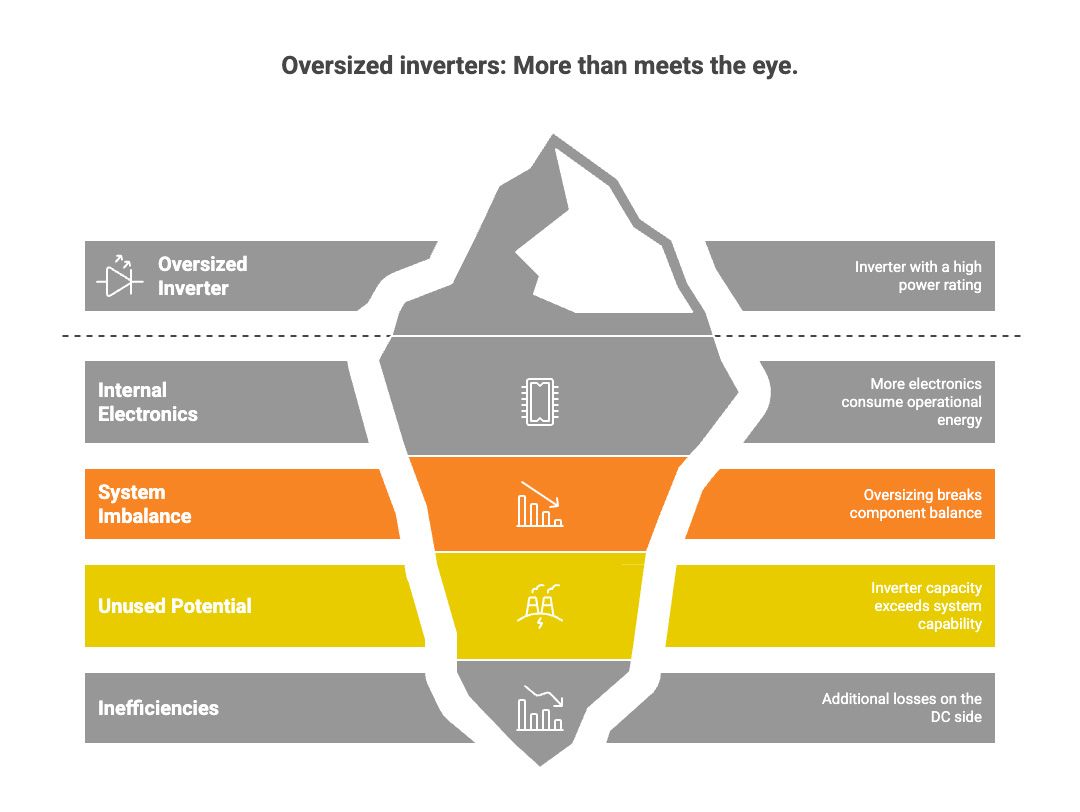
Yet this misconception is incredibly common. Many beginners assume: “If I install a bigger inverter, the whole system becomes more powerful.” In reality, the opposite is often true. Oversizing breaks the natural balance between system components, leaving you with unused potential on the AC side and unnecessary losses on the DC side. A 10 kW inverter paired with a 2 kW PV system is like installing a truck engine in a compact car: the engine can deliver power, but the rest of the system cannot supply enough fuel to let it perform. The inverter’s capacity only defines the maximum possible AC output, not the system's actual capability. The real limits always come from the panel array and the battery bank. If those components cannot withstand high loads, then the extra inverter capacity provides no practical benefit and often introduces additional inefficiencies.
The main drawback: higher idle consumption
The most significant downside of using an oversized inverter is its idle consumption – the energy the inverter draws simply to stay powered on, even when no loads are connected. Larger inverters contain bigger transformers, more powerful switching stages, and more extensive cooling systems. All of these components require electricity just to remain active. As a result, a 5–10 kW inverter commonly consumes 30–80 watts in idle mode, while compact 1–3 kW models typically use only 5–20 watts. This difference may look small on paper, but overnight it becomes a measurable drain. With no solar production at night, every watt of idle consumption must come directly from the battery. For example, a 50 W idle draw running for 10–12 hours means the system loses 500–600 Wh of energy, without powering anything helpful. With a small 5 kWh battery, that is 10–15% of the available capacity, disappearing every night due purely to inverter overhead.
A simple rule of thumb applies here: the bigger the inverter, the more it consumes just to stay awake. This issue is particularly noticeable in small or tightly optimized systems, where the overnight state-of-charge matters. Users often notice that the battery drops far more than expected during the night, even when no appliances are running. In many cases, the inverter itself is the only significant load.
Typical idle consumption ranges:
- Compact 1–2 kW inverters: 5–15 W
- Mid-range 3–5 kW units: 15–40 W
- Large 6–10 kW inverters: 30–80 W (sometimes more)
Because of this, checking the standby consumption specification is one of the first steps when choosing an inverter. Even a well-designed system can lose meaningful amounts of energy to an oversized unit. For smaller battery banks, this loss becomes a nightly burden, shortening runtime and reducing efficiency.
Other drawbacks of an unbalanced system
Idle consumption is the most significant and most noticeable consequence of using an oversized inverter, but it is not the only one. When the inverter’s capacity significantly exceeds what the panels and batteries can realistically support, the system becomes inefficient in several additional ways. These effects are less evident at first glance but still influence performance, longevity, and total cost of ownership.
Below are the three most common secondary drawbacks of an oversized or poorly balanced inverter setup.
Faster battery wear due to overnight drain
Because a large inverter consumes more power just to stay active, the battery experiences a deeper discharge every night. Even if the additional drain is only a few percent per cycle, over months and years, this adds up. Deeper and more frequent discharges contribute to:
- more total charge cycles,
- higher depth of discharge (DoD),
- faster degradation of lithium cells,
- reduced long-term usable capacity.
For small or aging battery banks, the impact is even more substantial. A system that should comfortably last through the night may instead wake up at a much lower state of charge simply because the inverter “ate” energy that could have been saved.
Increased noise and heat
Larger inverters are designed for higher loads, which means they often feature larger heatsinks and more powerful cooling fans. Even when the system is lightly loaded, these fans may activate more frequently to maintain internal temperature. This can lead to:
- noticeably louder operation,
- higher internal operating temperature,
- slightly reduced efficiency at low loads.
In small technical rooms or indoor installations, the added noise and heat output can be inconvenient or require additional ventilation.
Higher purchase cost without real benefit
Finally, a large inverter is simply more expensive. If the upstream components cannot deliver enough power to take advantage of the inverter’s capacity, the extra money brings no practical gain. Instead, you pay more upfront, then continue paying through higher idle losses and faster battery wear. In short, oversizing an inverter rarely improves system performance, but it consistently increases costs.
When a large inverter is NOT a problem
Although an oversized inverter can introduce extra losses and additional costs, there are situations where choosing a larger model is entirely justified and may even be the best long-term decision. Not every system needs to be perfectly matched from day one. In many real installations, the inverter is selected with the future in mind, not only the current configuration. One of the most common reasons for choosing a larger inverter is future expansion. If the current battery bank or PV array is small but you plan to increase capacity later, it makes sense to install the inverter upfront. The inverter often has the longest lifespan in the system, sometimes outlasting both the batteries and the solar modules. By selecting a more powerful unit now, you eliminate the need to replace or reconfigure it when you add more panels or upgrade your storage. In this scenario, the temporary imbalance is intentional and does not represent wasted potential.
A second case where oversizing is not a problem is when the battery bank is large enough that overnight idle consumption has little impact. If your storage capacity is 20–40 kWh or more, losing a few hundred watt-hours overnight is negligible. Many off-grid cabins, homesteads, and standalone systems with generator backup easily absorb these losses without affecting daily autonomy. Here, the bigger inverter does not threaten nighttime runtime and therefore does not meaningfully reduce system efficiency.
Finally, some inverter product lines are engineered so that all models from the smallest to the largest share nearly the same idle consumption. In such designs, choosing a higher-power model does not increase overnight drain. If the manufacturer’s datasheet confirms uniform idle usage, selecting a larger unit simply provides higher load capability without the typical penalty of increased standby losses. In short, a large inverter becomes a problem only when it introduces inefficiency without delivering value. When chosen for the right reasons and within the proper context, it can be a perfectly sensible component of a well-designed solar system.
How monitoring helps you understand whether your inverter is the right size
Even a system that looks balanced on paper can behave very differently in real-world operation. The only way to clearly understand whether your inverter is appropriately sized, or unnecessarily oversized, is to look at actual performance data over days, weeks, and months. Modern IoT monitoring tools make this easy, giving system owners visibility into how the inverter, battery, and PV array interact throughout the day. KaaIoT Energy Data Logger simplifies this process by collecting detailed telemetry from the inverter, PV array, and battery bank in real time. The device aggregates idle consumption, temperature, output power, cycle count, and other parameters, allowing you to evaluate system balance with objective evidence rather than assumptions.
What exactly you need to monitor
To decide whether your inverter is too large, several specific metrics matter most:
- Idle consumption – how many watt-hours the inverter uses in standby mode over 24 hours. This is the key factor determining whether a large model wastes energy at night.
- Overnight battery discharge – how much SOC the battery loses when no loads are running. This shows whether the inverter itself is draining the battery.
- PV production vs. inverter capacity – whether the solar array ever comes close to the inverter’s rated AC output. A large mismatch often indicates over-sizing.
- Battery cycle statistics – deeper or more frequent cycles caused by higher idle consumption reduce battery lifespan.
- Inverter temperature at different loads – oversized inverters sometimes run hotter or activate cooling fans more often, which affects noise, efficiency, and longevity.
With a data logger capturing all these parameters automatically, you can clearly see patterns that are invisible without instrumentation.
Why monitoring matters
Monitoring transforms the inverter-sizing question from guesswork into a data-driven decision. It allows you to:
see exactly how many watts the inverter “consumes by itself”;
determine whether the inverter is significantly larger than your PV and battery requirements;
understand whether downsizing could reduce costs or improve battery lifespan;
identify inefficiencies early, before they accumulate into wasted energy.
With the correct data, evaluating inverter size becomes simple. You can track real behavior, quantify losses, and confidently decide whether your current inverter is the right fit or whether a smaller one would make your system more efficient, quieter, and more economical.
You may be interested in: Choosing the right data logger for your PV system
Conclusion
Choosing the right inverter size is not just a matter of picking the largest unit you can afford. A solar system works efficiently only when its components are balanced: the PV array supplies energy, the battery stores it, and the inverter converts it with minimal overhead. When the inverter is significantly larger than the rest of the system, the result is often higher idle consumption, deeper nightly battery discharge, increased wear, and unnecessary upfront cost – all without providing any real performance benefit. However, oversizing is not always a mistake. It can be the right strategy if you plan to expand your system, if your battery bank is large enough to absorb nightly losses, or if your inverter model has uniformly low standby consumption across the product line. The key is understanding your system’s actual behavior, not relying on assumptions.
This is where proper monitoring becomes essential. By tracking idle draw, PV output, battery cycles, and inverter temperature, you can clearly see whether your inverter is working efficiently or simply consuming power for no reason. KaaIoT Energy Data Logger turns this into a data-driven decision, helping you evaluate real-world performance and optimize your system with confidence.