
Connected sensors for efficient hydrogen storage and transport
April 20, 2026Hydrogen infrastructure expands and this is why ensuring safe storage and transport becomes more complex. Connected sensors integrated into IoT systems address this challenge by providing continuous monitoring and operational visibility. Sensor networks collect data on pressure, temperature, gas concentration, location, and environmental conditions and transmit it to centralized platforms for analysis. These systems detect anomalies, support predictive maintenance, and help optimize logistics across hydrogen supply chains. Now, such monitoring architectures are increasingly standard in hydrogen storage facilities and transport fleets.
Within hydrogen infrastructure, connected sensors enable:
- Continuous monitoring of storage and transport conditions,
- Early leak detection and hazard prevention,
- Predictive maintenance of critical equipment,
- Optimization of logistics and delivery routes,
- Data-driven operational decisions.
Let's take a look at the sensor technologies used in hydrogen monitoring systems and how they improve storage and transport operations.
Sensor technologies behind connected hydrogen monitoring
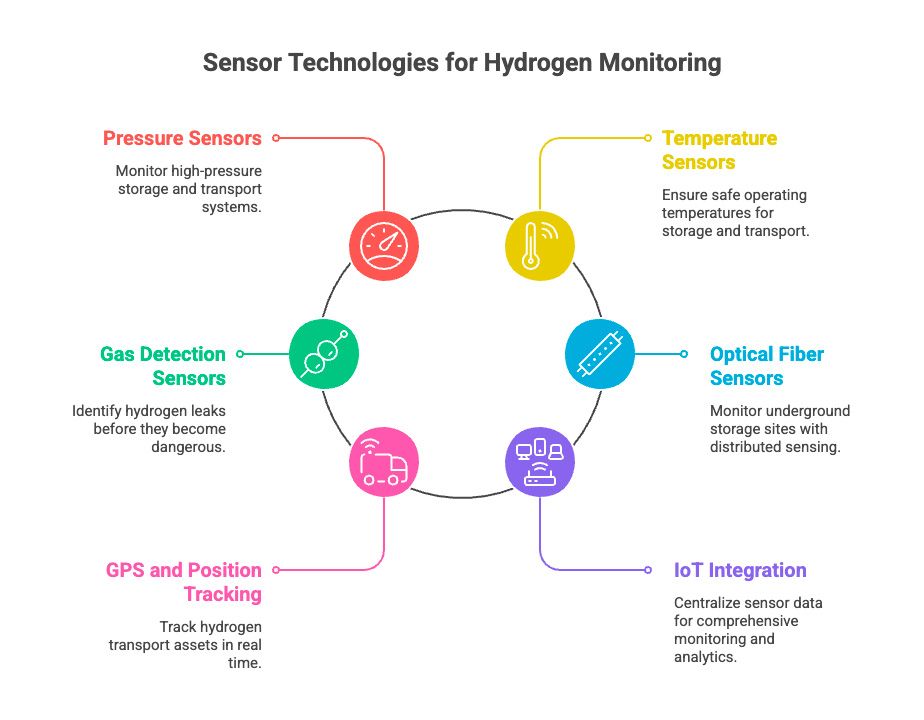
Modern hydrogen infrastructure relies on multiple categories of sensors working together as an integrated monitoring system. Each sensor type measures a different parameter that contributes to safe storage and transport operations.
Pressure sensors
Hydrogen is typically stored at extremely high pressures. In industrial storage tanks and transport cylinders, pressures commonly range from 350 to 700 bar, while specialized systems can monitor levels up to 600 bar. Pressure sensors are, therefore, one of the most critical components in hydrogen infrastructure. These sensors provide continuous telemetry that allows operators to detect abnormal pressure fluctuations that may indicate leaks, structural stress, or equipment failure. Advanced industrial sensors are designed to function within harsh operating environments, including explosive atmospheres. For this reason, many hydrogen monitoring sensors comply with ATEX certification, ensuring safe operation in hazardous environments. Continuous pressure monitoring also enables automated safety responses. When thresholds are exceeded, systems can trigger alarms, activate shutdown procedures, or isolate sections of the network.
Temperature sensors
Hydrogen storage environments often involve extreme temperatures. Cryogenic liquid hydrogen storage, for example, requires temperatures near −253°C, while transport systems and industrial environments may operate between −25°C and +85°C. Temperature sensors ensure that storage and transport systems remain within safe operating conditions. Temperature anomalies can indicate insulation failures, cooling system malfunctions, or early-stage equipment degradation. When integrated into IoT monitoring platforms, these sensors allow operators to identify trends that may lead to system instability.
Gas detection sensors
Hydrogen’s molecular structure allows it to escape through microscopic openings, making leak detection essential. Gas detection sensors measure hydrogen concentrations in the air and can identify even very small leaks before they become dangerous. Modern hydrogen detection technologies include electrochemical hydrogen sensors, catalytic bead sensors, semiconductor gas sensors and optical detection systems. Optical and nanohybrid sensing technologies are particularly promising. These systems combine nanoscale materials with optical measurement techniques to achieve extremely high sensitivity. They can detect hydrogen concentrations at very low levels and respond quickly to changing conditions.
Optical fiber sensors
In subsurface hydrogen storage, such as underground caverns or geological formations, traditional sensors are difficult to deploy. Optical fiber sensors offer an effective solution for monitoring underground environments. These sensors are capable of measuring multiple parameters simultaneously, including hydrogen concentrations, methane presence, temperature gradients and chemical composition of surrounding materials. Because optical fiber sensors operate along the length of a cable, they provide distributed sensing capabilities across large areas. This allows operators to monitor entire underground storage sites with high spatial resolution.
GPS and position tracking sensors
Hydrogen transport involves fleets of trucks, tankers, and containers moving between production facilities, storage hubs, and end users. GPS sensors enable real-time tracking of these assets. Modern IoT-based location systems can achieve position accuracy of around 3 meters, particularly when using long-range connectivity technologies such as LoRaWAN. These sensors allow operators to monitor vehicle locations, delivery schedules, and route conditions in real time. Position data also feeds into logistics optimization algorithms that reduce unnecessary travel and improve delivery efficiency.
Integration into IoT platforms
Sensor data alone has limited value unless it is integrated into a centralized monitoring environment. IoT platforms collect telemetry from thousands of connected devices and process it using data analytics and machine learning.
These platforms enable capabilities such as:
- Centralized dashboards for operational monitoring;
- Real-time alerts via SMS, email, or automated systems;
- Predictive maintenance analytics;
- Historical data analysis and trend detection.
For example, KaaIoT is an example of how hydrogen monitoring systems can aggregate sensor telemetry from distributed infrastructure into unified dashboards. This allows operators to visualize pressure, temperature, and environmental data in real time while configuring automated rules for anomaly detection. The integration of sensor networks with IoT platforms is a key factor enabling scalable hydrogen infrastructure.
Connected sensors in hydrogen storage infrastructure
Hydrogen storage is one of the most complex components of the hydrogen value chain. Different storage methods require specialized monitoring systems to ensure safety and efficiency.
High-pressure storage tanks
Many hydrogen facilities use compressed gas storage tanks, operating at pressures between 350 and 700 bar. These tanks are commonly used at hydrogen fueling stations, production facilities, and transport hubs. Connected sensors monitor critical parameters such as:
- Internal tank pressure;
- Surface temperature;
- Structural integrity indicators;
- Environmental conditions.
Continuous monitoring allows operators to detect abnormal conditions early. For example, pressure changes may indicate leaks or overpressurization, while temperature anomalies may signal equipment malfunctions. IoT-based monitoring systems can automatically analyze sensor data to detect patterns associated with potential failures. Predictive maintenance models help operators schedule inspections or repairs before equipment fails.
Cryogenic liquid hydrogen storage
Hydrogen can also be stored as a cryogenic liquid at extremely low temperatures. Liquid hydrogen storage allows higher energy density compared to compressed gas but introduces additional technical challenges. Cryogenic storage systems require constant monitoring of temperature stability, pressure levels, boil-off gas rates and insulation performance. Connected sensors help operators manage these variables in real time. By monitoring boil-off rates and temperature gradients, facilities can optimize cooling systems and reduce energy consumption.
Underground hydrogen storage
Large-scale hydrogen storage is increasingly being implemented in underground salt caverns, depleted gas reservoirs, and geological formations. These storage methods offer large capacity and cost advantages. Real-time sensor monitoring is essential in these environments because underground conditions are difficult to access physically. Optical fiber sensors and distributed sensing technologies allow operators to monitor gas composition changes, pressure variations and structural stability of geological formations. Studies indicate that underground hydrogen storage may become the most economical storage option, with monitoring systems helping maintain safe conditions while minimizing operational costs. Continuous sensor monitoring also helps prevent leaks and ensures environmental safety. When integrated with predictive analytics, these systems can identify anomalies before they become safety hazards.
Connected sensors in hydrogen transport
Hydrogen transport infrastructure involves complex logistics networks. Hydrogen must be delivered safely and efficiently from production facilities to industrial users, fueling stations, or export terminals. Connected sensors are increasingly used to optimize transport operations.
- Fleet monitoring and tracking. Transport vehicles carrying hydrogen are equipped with sensors that monitor tank pressure and temperature, vehicle location and movement, environmental conditions and fuel consumption. GPS-enabled monitoring allows operators to track vehicles in real time and ensure they follow safe and efficient routes.
- Route optimization using IoT data. Sensor telemetry combined with machine learning enables dynamic route optimization. Algorithms analyze data such as traffic conditions, delivery schedules, vehicle performance, fuel consumption patterns. Reinforcement learning models can adjust delivery routes in real time based on operational conditions. Studies suggest that such systems can reduce emissions from transport operations by up to 30%, while also lowering fuel consumption and operational costs. These optimizations can translate into approximately $15,000 in savings per logistics scenario, depending on fleet size and transport distances.
- Inventory and supply chain visibility. Connected sensors also provide visibility into hydrogen inventories during transport. Platforms can track container fill levels, delivery status, and supply chain performance. This information allows operators to reduce unnecessary transport trips, optimize storage utilization, and improve delivery planning. As hydrogen supply chains expand, such monitoring capabilities will become essential for managing distributed infrastructure.
Operational benefits and industry impact
The deployment of connected sensor systems in hydrogen infrastructure produces measurable improvements in safety, efficiency, and sustainability.
| Aspect | Efficiency gains | Emissions/Cost impact |
|---|---|---|
| Storage monitoring | Real-time parameter control | Underground storage reduces cost to about $3.30/kg H₂ |
| Transport optimization | Dynamic route planning | Up to 30% emissions reduction |
| Safety monitoring | Predictive anomaly detection | Around 30% reduction in incidents |
Improved safety. Hydrogen safety is one of the primary concerns for operators and regulators. Sensor networks enable proactive risk management by detecting anomalies before they escalate.
Lower logistics costs. By optimizing routes and transport schedules, connected sensor systems reduce fuel consumption and operational inefficiencies. Logistics costs can decrease by up to 25% when predictive analytics and real-time monitoring are integrated into supply chain operations.
Reduced environmental impact. Hydrogen is intended to support decarbonization goals, but infrastructure operations also generate emissions. Optimized logistics and monitoring systems can significantly reduce transport-related emissions. Advanced monitoring systems combined with renewable hydrogen production can reduce lifecycle emissions from 9.00 to 0.20 kg CO₂-equivalent per kilogram of hydrogen, representing a 97.8% reduction.
Predictive maintenance. Predictive maintenance is another major advantage of IoT sensor systems. Instead of relying on fixed inspection schedules, operators can monitor equipment conditions continuously. Machine learning models analyze sensor data to detect early signs of wear or failure. Maintenance can then be scheduled before equipment breaks down, reducing downtime and improving infrastructure reliability.
You may be interested at: Current state of the market: scale, growth, and forecasts for hydrogen transport
Conclusion
As hydrogen infrastructure expands globally, monitoring technologies will continue to evolve. Future systems are likely to incorporate:
- AI-driven anomaly detection that identifies risks automatically;
- Digital twins of hydrogen infrastructure for real-time simulation and operational planning;
- Edge computing architectures that process sensor data locally for faster responses;
- Advanced nanomaterial sensors capable of detecting ultra-low hydrogen concentrations.
Hydrogen is projected to account for up to 20% of global energy demand by 2050, according to several energy transition scenarios. Supporting this scale will require highly reliable storage and transport infrastructure, where connected monitoring systems become a fundamental operational layer. IoT platforms provide the foundation for managing these sensor networks at scale. KaaIoT demonstrates how telemetry from pressure, temperature, gas detection, and location sensors can be aggregated into unified dashboards, enabling real-time monitoring, rule-based alerts, and predictive analytics across distributed hydrogen assets.
For operators building hydrogen infrastructure, from storage facilities to transport fleets, the ability to integrate sensors, process telemetry, and automate monitoring workflows will increasingly determine operational safety and efficiency. If you are exploring connected monitoring for hydrogen systems, learn how KaaIoT supports scalable device connectivity, real-time telemetry processing, and operational dashboards for industrial IoT deployments.