
5 IoT trends defining smart infrastructure in 2026
March 09, 2026In 2026, the IoT strategy is no longer centered on connectivity expansion. The defining challenge has shifted toward system design, governance, and long-term scalability. Organizations deploying IoT at infrastructure scale must now balance distributed intelligence, cybersecurity posture, energy optimization, and cross-platform integration within a unified architectural framework. The discussion has moved from “how many devices are connected” to “how effectively systems operate under real-world constraints.” Reliability under network disruption, latency-sensitive decision loops, embedded AI inference, and compliance-driven security models are becoming baseline expectations rather than differentiators.
The 5 trends that follow reflect structural changes in how IoT systems are engineered and deployed – with implications for smart buildings, industrial operations, utilities, and enterprise infrastructure.
IoT market overview: growth, scale, and future projections
Independent market data confirms that IoT investment continues to expand in both scale and economic significance. Key quantitative indicators include:
- According to Fortune Business Insights, the global IoT market reached approximately USD 864 billion in 2025, with projections exceeding USD 1 trillion in 2026 and continuing toward multi-trillion valuations over the coming decade.
- Long-term forecasts estimate that the broader IoT ecosystem could approach USD 5.3 trillion by 2035, driven by industrial automation, connected infrastructure, and logistics digitization.
- Statista projects more than 22 billion IoT connections by 2026, increasing toward 32 billion by 2030 as enterprise instrumentation deepens.
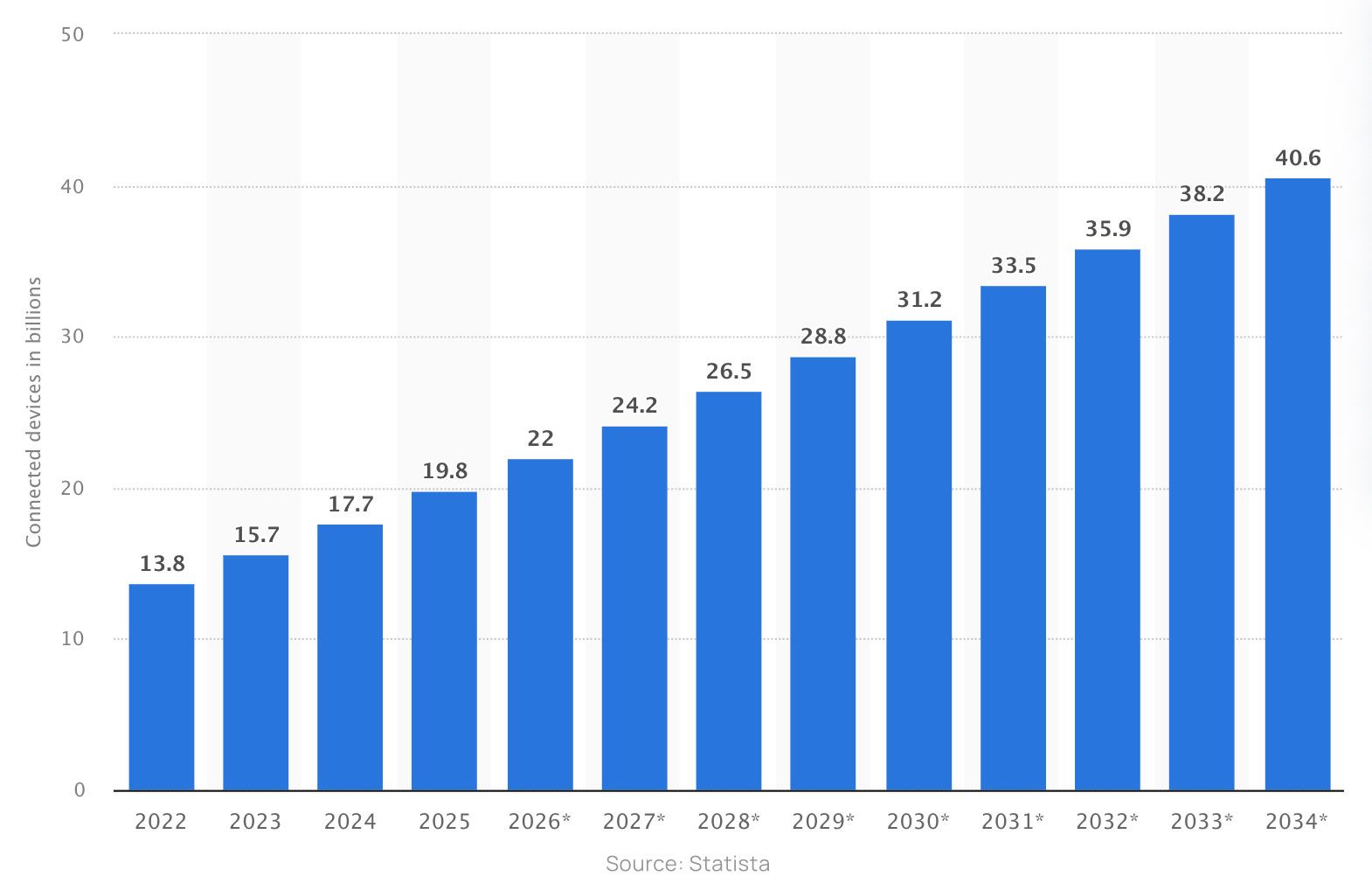
These figures underscore the economic scale of IoT adoption and confirm that enterprise and industrial deployments remain the primary engines of sustained growth.
1. Edge-native architectures compute at the source
By processing data at or near the sensor level, IoT systems can execute real-time environmental responses, safety interlocks, and operational analytics without depending on cloud roundtrips. This ultra-low latency capability is particularly important in smart buildings and industrial settings where milliseconds can influence system stability, occupant safety, or production continuity. Edge architectures also enhance resilience. Local compute nodes maintain operational logic even during network interruptions, ensuring continuity for systems such as leakage detection, fire monitoring, access control, and energy management. Rather than halting during connectivity loss, subsystems can continue to operate autonomously while synchronizing with central platforms once connectivity is restored.
Distributed processing reduces the volume of raw telemetry transmitted to the cloud. By filtering, aggregating, and analyzing data locally, organizations can reduce bandwidth consumption and cloud storage requirements, in some cases by up to 40 percent. This becomes especially significant in high-density sensor environments where continuous streaming would otherwise strain infrastructure. Edge ecosystems increasingly combine smart gateways, micro-data centers, and device-level compute accelerators. This layered approach supports localized decision loops while preserving hierarchical analytics at the enterprise level. For smart buildings, edge computing enables immediate responses to indoor air quality fluctuations, unexpected load spikes, and safety anomalies. It also supports distributed control strategies in which HVAC, lighting, and security systems operate semi-autonomously yet remain fully integrated within centralized management frameworks.
You may be interested in: The real cost of closed clouds in energy monitoring
2. AIoT, edge AI, and predictive intelligence
Artificial intelligence and IoT have converged into what is now widely described as AIoT, one of the most structurally significant developments shaping 2026 deployments. The integration of onboard machine learning frameworks such as TinyML and specialized AI accelerators into IoT nodes is transforming how infrastructure systems sense, interpret, and respond to real-world conditions. Instead of passively transmitting telemetry for retrospective analysis, intelligent devices can now detect anomalies in real time, forecast equipment degradation via pattern recognition, optimize resource consumption dynamically, and trigger automated corrective actions without relying on continuous cloud access. Decision-making cycles are shortened, and operational responsiveness improves accordingly.
In enterprise and industrial environments, the implications are measurable. Predictive maintenance programs supported by reliable anomaly-detection models can reduce unplanned downtime by up to 50 percent when vibration patterns, thermal behavior, and load deviations are continuously analyzed at the edge. Resource-constrained devices equipped with embedded inference capabilities can identify early signs of failure locally, minimizing reliance on centralized data processing pipelines and reducing both latency and bandwidth requirements. Within smart building ecosystems, AIoT enables continuous energy optimization by correlating occupancy trends, external weather conditions, and system setpoints in real time. HVAC loads and lighting schedules can be dynamically adjusted to balance occupant comfort, operational efficiency, and sustainability targets. Over time, such adaptive control strategies generate cumulative efficiency gains while preserving reliability.
3. Next-gen connectivity: 5G, LPWAN, and network intelligence
Connectivity remains the structural backbone of IoT architecture, but the network environment of 2026 is far more segmented and purpose-driven than in earlier deployment cycles. Rather than relying on a single transport layer, enterprises now design connectivity stacks based on latency sensitivity, device density, power constraints, and security segmentation requirements. The result is a hybrid ecosystem in which multiple wireless and wired technologies coexist within a unified architecture.
Advanced cellular and private networks
Fifth-generation connectivity has matured into a practical enabler of real-time industrial and infrastructure applications. 5G URLLC supports end-to-end latency in the 1-5 millisecond range, which is critical for robotics coordination, safety interlocks, and synchronized automation in manufacturing environments. This performance level enables deterministic communication patterns previously unattainable in wireless systems. Private 5G deployments are increasingly adopted in enterprise settings, allowing organizations to operate isolated, high-performance network slices without sharing capacity with public mobile traffic. These private infrastructures enhance security segmentation, guarantee predictable throughput, and support mission-critical applications such as remote machinery control, industrial automation, and high-density IoT deployments within controlled facilities.
LPWAN and hybrid connectivity architectures
While 5G addresses high-bandwidth, low-latency scenarios, low-power wide-area networks remain essential for large-scale sensor deployments. Protocols such as NB-IoT and LoRaWAN provide extended range, minimal energy consumption, and cost-effective connectivity for environmental monitoring, utility metering, and distributed infrastructure telemetry. Smart buildings and industrial campuses increasingly rely on hybrid connectivity stacks that integrate Wi-Fi 6 or Wi-Fi 7, cellular networks, Ethernet backbones, and LPWAN overlays. This layered approach enables organizations to balance:
- Latency requirements for time-sensitive control systems;
- Coverage range across large facilities or campuses;
- Device density in high-instrumentation environments;
- Power efficiency for battery-operated sensors;
- Security isolation for critical subsystems.
4. Sustainability and green IoT
IoT-enabled energy management systems are capable of reducing overall consumption by 20 to 30 percent in commercial facilities when predictive control, occupancy analytics, and adaptive setpoint management are implemented correctly. Smart metering infrastructures provide granular visibility into electricity, gas, and water usage, enabling continuous optimization rather than periodic auditing. Beyond consumption metrics, connected sensor networks increasingly support carbon tracking and emissions quantification aligned with Scope-1 and Scope-2 reporting frameworks, strengthening compliance and transparency in enterprise sustainability programs. Device-level innovation also contributes to environmental performance. Modern IoT hardware increasingly incorporates energy-harvesting mechanisms, such as solar, thermal, or vibrational capture, alongside adaptive duty cycles that extend battery life and reduce maintenance frequency. These design improvements lower lifecycle environmental impact while supporting large-scale sensor deployments across campuses and infrastructure networks.
Within smart building environments, IoT does more than measure resource use; it actively reshapes operational behavior. HVAC loads adjust dynamically based on occupancy and external climate conditions, demand-response mechanisms synchronize with utility pricing signals, and grid-interactive strategies balance cost optimization with carbon intensity reduction. Sustainability performance is therefore no longer a secondary outcome of efficiency initiatives but a core parameter within IoT return-on-investment calculations, directly linking operational resilience, cost control, and environmental accountability.
5. Interoperability and standards
Fragmented device ecosystems remain one of the most persistent barriers to enterprise-grade IoT scalability. As deployments expand across facilities, campuses, and industrial networks, proprietary protocols and vendor-specific integrations increase complexity, slow implementation cycles, and elevate long-term operational risk. In 2026, interoperability is no longer viewed as a technical convenience but as a structural requirement for sustainable growth.
Industry-wide adoption of open standards and unified integration frameworks is accelerating architectural maturity. Widely adopted technologies include:
- MQTT, enabling lightweight, reliable, and bi-directional messaging across distributed IoT environments;
- OPC UA, providing industrial-grade interoperability and secure data exchange across heterogeneous operational technology systems;
- Matter and Thread, supporting cross-platform compatibility in smart building and connected device ecosystems;
- Unified APIs, abstracting vendor differences and simplifying device onboarding, management, and lifecycle control.
These standards reduce vendor lock-in, lower integration costs, and allow multi-vendor subsystems to operate cohesively within unified management platforms. In smart building environments, this interoperability enables HVAC, lighting, access control, and metering systems to integrate into centralized optimization layers, supporting cross-system load balancing and coordinated automation strategies. Although interoperability is often invisible to end users, its architectural impact is foundational. Standardized ecosystems scale predictably and adapt to evolving requirements, while fragmented proprietary stacks introduce technical debt and long-term operational constraints.
You may be interested in: How to unlock IoT data for automation and operational efficiency
Conclusion
The IoT landscape in 2026 is defined by intelligence, scale, and resilience. Distributed edge architectures improve system responsiveness and reliability; AI-enabled IoT converts raw telemetry into real-time operational decisions; next-generation connectivity enhances performance across dense device environments; and security-by-design frameworks protect both data integrity and operational continuity. Sustainability integration and interoperability standards further reinforce IoT’s role as foundational infrastructure rather than experimental technology. For enterprises and smart infrastructure operators, these developments are not abstract trends but architectural imperatives. Future-ready IoT deployments must balance local autonomy with centralized oversight, integrate predictive intelligence with operational control, and ensure security and scalability across heterogeneous environments.
Organizations that pursue structured IoT modernization in 2026 can expect measurable outcomes, including:
- Accelerated time to value through intelligent automation;
- Improved uptime and operational predictability;
- Reduced lifecycle costs and controlled risk exposure;
- Strengthened sustainability performance aligned with ESG objectives.
IoT now operates at the intersection of digital transformation and physical infrastructure management. Its strategic implementation will increasingly determine operational competitiveness, resilience, and long-term enterprise performance.