
Scenting applications for businesses: why ready-to-use IoT platforms often outperform DIY systems
December 15, 2025Scent marketing has grown into a measurable business tool rather than a decorative add-on. According to Global Market Insights, global aromatherapy diffusers market size was valued at USD 1.5 billion in 2024 and is anticipated to register a CAGR of over 12.1% between 2025 and 2034. The market is driven by growing consumer interest in natural health solutions and stress management: retailers, hotels, offices, and wellness operators adopt ambient scenting to influence customer behavior, strengthen brand identity, and improve comfort in spaces.
However, as soon as companies scale from one or two diffusers to dozens of devices across multiple locations, scenting becomes not only a marketing function but also an operational and technological challenge. This is the point where the choice emerges: build your own monitoring and control system, or adopt a ready-made IoT cloud platform?
For most small and mid-sized businesses, the first option quickly becomes impractical.
This article explains why.
How businesses use scenting today
Scenting has become a functional business tool rather than an aesthetic extra. Its use has expanded from marketing departments to operations, facility management, and even HR. Different industries apply scenting with clear, measurable objectives:
Retail uses signature aromas to increase dwell time, influence emotional perception, and strengthen brand recall. Nike reported that introducing ambient scent increased customers’ intention to purchase by up to 84%. Other studies show that scented retail zones can increase browsing time by 15-20%, directly affecting conversion rates.
Hotels and hospitality rely on HVAC-integrated scenting to maintain consistency across large, open spaces such as lobbies, spas, and guest corridors. A uniform scent profile contributes to brand recognition just as strongly as visual identity and is often cited in guest satisfaction surveys.
Offices and corporate environments use low-intensity ambient scenting as part of workplace well-being programs. Research in environmental psychology suggests that certain aromas (e.g., citrus or mint) can reduce perceived stress and improve concentration, supporting HR goals related to focus and employee comfort.
Healthcare and wellness centers deploy controlled aromatherapy to create predictable, calming conditions. This is particularly important in waiting rooms, rehabilitation centers, and spa facilities, where scent consistency helps regulate visitor anxiety levels.
Real estate and showrooms rely on scenting to shape first impressions – a factor that drives up to 70% of purchase decisions in residential real estate. A curated scent strengthens emotional resonance during property tours and increases perceived property value.
Across these industries, modern scenting no longer revolves only around diffusion quality. The complexity increases with scale: multi-room environments, varying occupancy patterns, consumable management, and the need for a uniform brand experience across locations. As a result, commercial scenting systems, especially HVAC-integrated diffusers, now operate more like IoT devices than simple fragrance dispensers. They require:
- precise scheduling;
- real-time operational telemetry;
- multi-zone automation;
- remote maintenance;
- centralized quality control.
This shift is the reason why scent marketing naturally intersects with IoT. Businesses now treat scenting as part of their digital facility infrastructure rather than a standalone device category.
You may be interested at: how scent marketing connects to IoT principles
The technical side of modern scenting: hardware, HVAC integration, and IoT telemetry
Modern scenting infrastructure relies on several categories of hardware, ranging from compact wall-mounted diffusers for small retail spaces to standalone devices for mid-sized environments and fully HVAC-integrated systems for hotels, offices, malls, and large public venues. HVAC diffusion has become the industry standard because it ensures consistent scent distribution across zones and reduces consumable waste, but this also raises operational complexity. These systems must control multiple parameters simultaneously: scent intensity, cartridge consumption, fan or pump cycles, energy usage, internal error states, and schedule adherence, while maintaining stable communication with the building’s infrastructure.
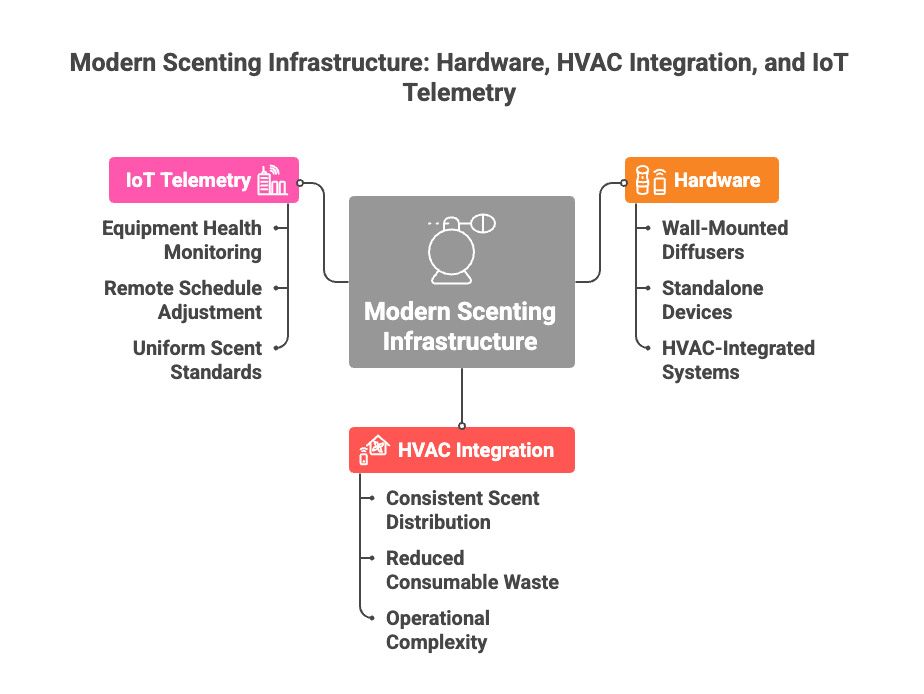
Because each diffuser generates continuous operational data, managing them without a unified IoT platform quickly becomes inefficient. Technicians are forced to perform manual checks, replace cartridges reactively rather than predictively, and troubleshoot inconsistent behavior across sites. Centralized telemetry and automation solve this problem by allowing operators to monitor equipment health, adjust schedules remotely, and enforce uniform scent standards across the entire network.
You may be interested at: An overview of HVAC-integrated scenting systems and their IoT capabilities
Why ready cloud IoT platforms outperform DIY systems for most businesses
Building an internal IoT platform may seem attractive when a company operates a few scent diffusers. But once the network grows to 20, 50, or 100+ devices, the real financial, technical, and operational load becomes visible. Mature cloud IoT platforms solve these challenges out of the box, offering the stability and scalability that small teams rarely achieve cost-effectively.
Total cost of ownership (TCO): DIY engineering quickly outpaces its value
A complete IoT backend requires far more than a dashboard. It includes server infrastructure, telemetry pipelines, device provisioning logic, security layers (TLS, RBAC, audit logs), continuous DevOps monitoring, anomaly detection, and reliable OTA firmware management. Maintaining this stack typically costs USD 150,000–300,000+ per year for small and mid-sized companies without counting mobile apps, analytics, or custom automations. Enterprises can absorb this cost; small and mid-sized scenting businesses usually cannot.
Time-to-market: cloud platforms deploy in days instead of months
Cloud providers ship the critical components pre-built: dashboards, device templates, grouping logic, automation tools, alerting systems, and historical insights. This dramatically accelerates rollout. For example, the KaaIoT Scent System dashboards allow fleets of diffusers to be onboarded with minimal configuration. A comparable DIY system typically requires 6-12 months of development to reach a similar level of operational maturity.
Scalability: multi-site growth without technical debt
Scenting networks scale non-linearly. Ten devices can be checked manually. Fifty already require structured maintenance schedules. At two hundred or more, operations break down without automation. Cloud IoT platforms enable stable expansion by providing fleet-level scheduling, bulk updates, unified telemetry, automated anomaly detection, and centralized firmware management. This ensures every location follows the same scenting standard and service quality, regardless of size.
Security & compliance: a non-negotiable layer most DIY systems undervalue
Because scent diffusers are connected endpoints, they fall under the same risk category as other IoT devices. A secure architecture must include TLS encryption, role-based access control, multi-tenant isolation, audit logging, and verifiable OTA updates, plus GDPR-compliant data handling for EU operators. Small teams often underestimate the complexity of maintaining these controls continuously, increasing exposure to operational and cybersecurity risks.
Interoperability: vendor-neutral platforms support the full device ecosystem
Commercial scent diffusers use a broad mix of communication protocols: MQTT, REST APIs, Modbus RTU/TCP, LoRaWAN, Wi-Fi/BLE hybrids, and proprietary gateways. DIY systems usually implement only the minimum required protocol set, limiting hardware compatibility and slowing the adoption of new diffuser models. Vendor-agnostic cloud platforms, by contrast, support multi-protocol environments out of the box and allow businesses to mix hardware from different manufacturers without rewriting integrations.
When building your own IoT scenting platform still makes sense
While ready-made IoT platforms outperform DIY systems for most businesses, there are several scenarios where building an internal solution is strategically sound. These cases share a common denominator: the organization already possesses (or plans to invest in) the engineering, DevOps, and security capabilities required to support a long-term IoT roadmap.
Large enterprises may choose DIY when scenting is part of a broader digital infrastructure program governed by internal IT teams. In these environments, the scenting module becomes just one component of an existing IoT layer that already handles device provisioning, telemetry pipelines, security enforcement, and user access logic. OEM hardware manufacturers also benefit from proprietary platforms because they control the entire ecosystem: device firmware, communication protocols, cloud logic, and user applications, allowing them to differentiate their product line and maintain tighter customer lock-in. Finally, DIY may be appropriate for ultra-specific use cases, such as R&D labs or highly customized automation workflows, where commercial platforms cannot meet niche requirements.
To clarify the distinction, the table below summarizes when DIY is advantageous versus when a cloud platform provides better ROI:
| Scenario | DIY platform | Ready cloud platform |
|---|---|---|
| Internal engineering, DevOps, cybersecurity teams | Suitable – teams can maintain complex IoT stacks | Not required, but still viable |
| OEM manufacturer controlling hardware + software ecosystem | Ideal – proprietary platform strengthens product strategy | Less relevant |
| Existing IoT infrastructure where scenting is a small module | Efficient – reuses existing pipelines | Useful if the internal platform is outdated |
| Highly specialized automation workflows | Best fit – custom logic needed | May not support niche scenarios |
| Small to mid-sized scenting service providers | High cost, slow rollout, high risk | Optimal – low TCO, fast deployment |
| Businesses without full-time IoT engineers | Not sustainable | Strong match |
For the vast majority of scenting service providers, especially small and mid-sized businesses, DIY development diverts resources away from revenue-generating functions such as sales, customer onboarding, and consumable logistics. The ongoing maintenance burden alone outweighs the value of owning custom code. In these cases, a modular, vendor-neutral cloud IoT platform delivers a stronger operational foundation at a fraction of the cost and effort.
Conclusion
As scenting evolves from a decorative feature into an operational discipline, the ability to monitor, automate, and scale diffuser fleets becomes a core business requirement. A consistent scent profile across multiple sites, predictable consumable usage, proactive maintenance, and real-time device health insights are now essential for delivering the level of experience customers expect. These capabilities depend not only on the diffuser hardware but also on the robustness of the IoT layer that powers it.
For most businesses – tiny and mid-sized scenting operators, integrators, and facility management providers – developing this IoT layer internally introduces unnecessary cost, technical risk, and deployment delays. Ready cloud platforms deliver the maturity, security, and scalability that DIY systems struggle to match, enabling companies to focus on their core commercial activities instead of maintaining complex backend infrastructure.
KaaIoT offers a complete, production-grade IoT solution specifically for commercial scenting systems, including HVAC-integrated diffusers and mixed-hardware fleets. Our platform includes real-time dashboards, secure device management, fleet-wide automation, telemetry analytics, and vendor-neutral integration options, all available out of the box.
If your organization is evaluating scent automation or planning to scale operations across multiple sites, our team can help you design the exemplary architecture and deploy a ready-to-use system quickly and cost-effectively.
Reach out, we’ll discuss your goals and recommend the most efficient path forward.