
Inverter overload protection: best practices and practical guidance
February 25, 2026Inverters are the heart of modern electrical systems, from solar photovoltaic (PV) installations to off-grid power solutions and industrial motor drives. Yet, one of the most common and damaging challenges these devices face is electrical overload. Overload conditions stress components, trigger protective shutdowns, reduce lifetime reliability, and can even lead to costly failures. So, what overload is, how it affects inverters, and how to protect your system – read on.
What is inverter overload and why does it matters
Inverters convert DC power from sources such as solar panels or batteries into AC power for electrical loads. An inverter overload occurs when the total demand exceeds the inverter’s rated capacity, forcing it to deliver more current than it is designed to handle. Unlike instantaneous faults such as short circuits, overload is typically a sustained condition that places prolonged electrical and thermal stress on internal components. In real-world systems, overloads most often arise when multiple high-power appliances start simultaneously, when motors or compressors introduce high inrush currents, when the inverter is undersized relative to peak demand, or when battery capacity and DC sources are degraded or poorly configured.
In photovoltaic systems, repeated overload conditions often result in frequent protective shutdowns, reduced energy availability, and accelerated component wear. A 2024 study presented at WCNPS reports that PV system efficiency losses were ~2.55% in a month without inverter failure, and reached ~14% in months when inverter failures occurred, illustrating how inverter events can materially impact generation performance. On the operational side, insurer/claims datasets and industry field analyses show that inverter issues can drive long repair cycles: Critical or major inverter claims average ~80 days of downtime, largely due to repair complexity and spare-part availability.
Core protection mechanisms in modern inverters
Most modern inverters include built-in overload protection features. These mechanisms work together to prevent damage and maintain safe operation:
1. Current limiting
When the load demand exceeds rated capacity, the inverter limits output current to a safe threshold. This prevents thermal and electrical stress. However, strict current limiting can cause the system to derate power output, affecting performance under high load.
2. Thermal protection
Overloads generate heat. Inverters use internal temperature sensors and cooling systems to reduce power output or shut down if temperatures approach unsafe levels. Thermal protection helps prevent catastrophic failures but may trigger false alarms under temporary peaks if poorly configured.
3. Automatic shutdown and reset logic
When overload is detected repeatedly or for extended durations, inverters often shut down automatically to protect themselves and connected loads. Some intelligent systems can attempt a soft restart after a cooling period, improving uptime without human intervention.
These protection strategies help manage overload, but they must be configured and supported by proper system design to be effective.
Sizing and selection: the first line of defense
Effective protection against inverter overload begins well before installation, at the system design stage. Proper inverter sizing is one of the most critical factors in preventing overload conditions and ensuring stable long-term operation. Focusing only on average power consumption is insufficient, as peak demand and startup surge currents, particularly from motors, pumps, compressors, and HVAC equipment, can be several times higher than the steady-state load. If these transient loads are not correctly accounted for, even an inverter that appears adequately rated on paper may experience frequent overload events.
Accurate sizing also requires realistic load profiling based on how the system will actually be used. This includes evaluating the simultaneous operation of multiple loads, variations in usage throughout the day, and potential future system expansion. Designs that rely on idealized or static assumptions often underestimate real-world demand, increasing the likelihood of overload and protective shutdowns.
At the same time, oversizing the inverter as a universal safeguard is not always an effective solution. Excessively oversized inverters may operate far below their optimal efficiency range, complicate system control logic, and introduce additional stress on connected components such as batteries, DC cabling, and protection devices. Balanced sizing, based on measured demand, surge behavior, and realistic growth expectations, remains the most reliable approach to minimizing overload risk while maintaining efficient system performance.
System-level strategies for overload protection
Beyond the inverter itself, overload protection becomes significantly more effective when implemented at the system level. Coordinating load behavior, energy sources, and monitoring mechanisms enables proactive management of overload risks, reducing both unplanned shutdowns and long-term component stress.
Load shedding and prioritization
Load shedding and prioritization mechanisms allow the system to actively manage demand before inverter limits are exceeded. An energy management system (EMS) continuously evaluates total load against available inverter capacity and disconnects non-critical consumers when predefined thresholds are reached. This approach is particularly effective in mixed-load environments where essential systems must remain operational while discretionary loads can be temporarily curtailed. By enforcing priority tiers and dynamic shedding rules, the system prevents overload events without requiring manual intervention, improving both uptime and operational predictability.
Battery and source management
Battery and source management play a critical role in absorbing short-term load spikes and stabilizing inverter operation. A properly configured battery management system (BMS), combined with intelligent inverter control, enables the system to supply transient peak demand from stored energy rather than forcing the inverter into overload. This coordination helps smooth rapid load fluctuations, maintain DC bus stability, and prevent protective trips caused by sudden current surges. In hybrid and BESS-enabled systems, effective source management also ensures that batteries are neither over-stressed nor underutilized during high-demand periods.
Monitoring and alerts
Continuous monitoring is essential for identifying overload risks before they escalate into faults or shutdowns. Tracking parameters such as output current, voltage, internal temperature, and protection trigger frequency provides visibility into how close the system operates to its limits. Smart inverters with communication capabilities can generate real-time alerts, support remote diagnostics, and expose historical trends that reveal gradual load growth or deteriorating conditions. Over time, this data enables predictive maintenance and informed adjustments to load profiles or protection thresholds, reducing the likelihood of recurring overload events.
Maintenance and inspection
Routine maintenance and inspection remain a foundational element of overload prevention, even in well-designed systems. Electrical issues such as loose connections, aging cables, or increased contact resistance can elevate operating temperatures and reduce effective capacity, indirectly triggering overload protection. Similarly, inadequate cooling, obstructed airflow, or outdated firmware may cause protection mechanisms to trip prematurely. Regular inspection of wiring integrity, ventilation paths, sensor accuracy, and software versions helps ensure that overload events are driven by genuine electrical conditions rather than avoidable system deficiencies.
Operational guidelines for preventing inverter overload
Minimizing inverter overload risk requires a combination of sound engineering decisions, realistic operational assumptions, and ongoing system oversight. Overload protection should not be treated as a single configuration step, but as a continuous design and operational discipline that evolves with the system over its lifetime. The following best practices reflect approaches commonly used in reliable PV, BESS, off-grid, and hybrid energy systems.
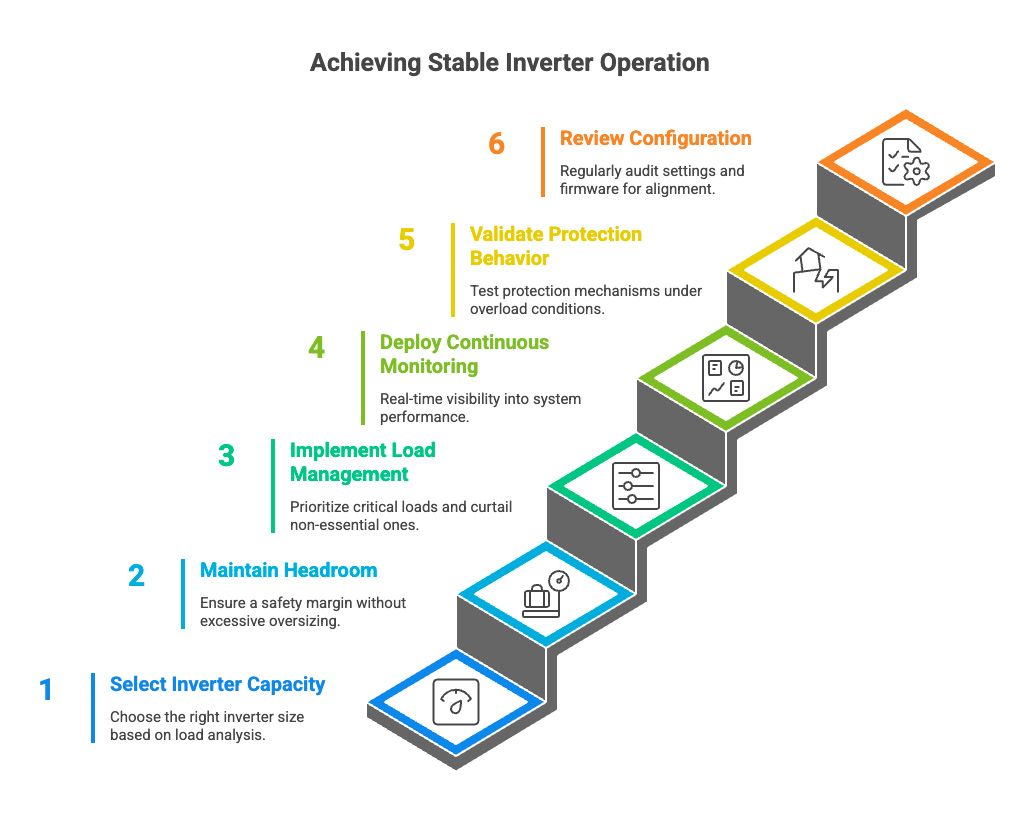
- Select inverter capacity based on comprehensive load analysis. Sizing decisions should be driven by measured or well-modeled load profiles, accounting for peak demand, startup surges, duty cycles, and load simultaneity. Average consumption alone is an insufficient basis for inverter selection and often leads to an underestimation of real operational stress.
- Maintain controlled headroom without excessive oversizing. A reasonable safety margin allows the inverter to tolerate short-term peaks and gradual load growth, but extreme oversizing can reduce efficiency, complicate control strategies, and increase stress on batteries, cabling, and protection devices. Headroom should be justified by documented demand scenarios rather than generic rules of thumb.
Implement active load management and prioritization. Critical loads should be clearly defined and protected, while non-essential loads must be curtailable when capacity limits are approached. Automated load shedding through an EMS significantly reduces the likelihood of sustained overload and improves system resilience under abnormal conditions. - Deploy continuous monitoring with actionable alerts. Real-time visibility into output current, inverter temperature, DC source stability, and protection event frequency allows operators to detect overload trends early. Alerting thresholds should be configured to prompt corrective action before protective shutdowns become frequent or disruptive.
- Validate protection behavior under real operating conditions. Pre-commissioning and acceptance testing should include controlled overload and high-demand scenarios to confirm that current limiting, thermal derating, and shutdown logic behave as expected. This step often reveals configuration issues that are not apparent under nominal loads.
- Review configuration, firmware, and system health on a scheduled basis. Load profiles evolve over time, firmware logic changes, and component aging alters system behavior. Periodic audits of inverter settings, protection thresholds, firmware versions, and physical installation conditions help ensure that overload protection remains aligned with actual operating reality.
Taken together, these practices form a layered defense against inverter overload. Rather than relying solely on built-in protections, they integrate design discipline, operational control, and ongoing verification to support stable, predictable, and long-term inverter operation.
Conclusion
Inverter overload protection is a system-wide design and operational strategy. Proper sizing, continuous monitoring, intelligent load management, and consistent maintenance all play a critical role in preventing overload conditions that lead to efficiency losses, unplanned downtime, and premature hardware degradation. As PV installations and energy storage systems continue to scale across residential, commercial, and industrial markets, the ability to detect, analyze, and respond to overload risks becomes increasingly important.
This is where system-level visibility makes a measurable difference. KaaIoT Universal Energy Controller enables continuous monitoring of electrical parameters, including current, voltage, load behavior, and overload-related events, providing operators with real-time insight into how close a system operates to its limits. By exposing overload trends early and supporting data-driven decisions around load management and configuration, such tools help shift overload protection from reactive shutdowns to proactive control.