Can solar and grid power be used at the same time?
December 22, 2025Homeowners who begin with a small number of solar panels and plan to expand over time often wonder: can solar power and grid power be used at the same time? This question appears frequently on solar forums because different inverters and metering setups behave very differently when solar and grid interact. In most modern systems, the answer is yes: solar and grid can operate simultaneously, sharing loads or supplementing one another when needed. The exact behavior depends on whether the system is grid-tie, hybrid, or off-grid with a transfer switch. Understanding these distinctions is crucial for anyone planning gradual solar expansion or trying to avoid unexpected energy charges.
This article explains how mixed solar–grid operation works and how Kaa helps monitor and control energy flows safely and efficiently.
How solar and grid work together in different system types
The way solar and grid power interact depends primarily on the inverter and system architecture. Some systems blend sources automatically, while others switch between them.
Grid-tie systems (no batteries)
In a classic grid-tie setup, the inverter synchronizes with the utility grid and feeds solar power directly into the home’s electrical system.
How it works:
- Solar power is used to supply household loads first.
- Any excess solar power is exported to the grid.
- When loads exceed solar output, the deficit is automatically drawn from the grid.
Solar and grid are always operating in parallel. There is no switching logic, just a continuous balancing of power flows. This setup requires proper utility approval and a reconfigured bidirectional meter. Without it, exported solar energy may be billed incorrectly.
Hybrid systems (solar + battery + grid)
Hybrid systems offer the greatest flexibility and enable simultaneous use of solar and grid power.
How it works:
- Solar prioritizes the loads; batteries can support or store energy.
- The inverter automatically blends solar, battery, and grid power depending on demand and available PV generation.
- When solar is insufficient, the grid seamlessly supplements the load.
- When solar produces more than the load, the excess can charge the battery or export to the grid (if allowed).
Hybrid systems are ideal for users who want gradual solar expansion, backup power, and full control over import/export behavior.
Off-grid systems with automatic transfer switch
Off-grid systems do not blend grid and solar power. Instead, the system uses one source at a time.
How it works:
- Solar and batteries power the loads until the battery voltage drops below a threshold.
- An automatic transfer switch (ATS) then switches all selected circuits to grid power.
- Once the batteries recover, the ATS switches back to solar power.
The switching is often fast enough that appliances barely notice, but the two power sources do not supply loads simultaneously.
Can solar and grid be used at the same time?
Solar and grid power can operate simultaneously, but only in systems designed for parallel operation. In hybrid and grid-tie configurations, the inverter continuously balances power flows between the solar array, the battery (if present), and the utility grid. This means solar can cover part of the load, while the grid automatically provides whatever additional power is needed. In practical terms, this looks like:
- Solar produces some power → loads consume it.
- If loads exceed what solar provides, the grid fills the gap.
- If solar produces more than the loads need → the excess may charge the battery or flow to the grid, depending on settings and local regulations.
- If the battery is part of the system, it can supplement solar power to reduce or eliminate grid usage.
This simultaneous operation is normal and expected. Modern hybrid inverters are specifically designed to synchronize their output with the grid and operate in “blended” mode. In contrast, off-grid systems with transfer switches cannot mix solar and grid; instead, they switch entirely from one source to the other.
You may be interested in: Why solar panels deliver less power and how proper array voltage fixes the problem
Why proper utility meter configuration matters
When solar and grid power operate together, the way your utility meter is configured determines how energy flows are measured and billed. This is especially important for grid-tie and hybrid systems, where solar may export excess power back to the grid. Modern utilities typically use digital bidirectional meters, but these meters must be correctly programmed to account for both imported and exported energy. If they are not configured for two-way metering, the homeowner may be charged incorrectly for the power their system sends back to the grid.
Historically, older mechanical “spinning disc” meters made this simple: when solar generation exceeded household consumption, the disc would spin backward, automatically reducing the measured usage. Today’s digital meters often include a ratchet function that counts all energy passing through them as consumption from the grid, unless the utility updates their configuration.
A properly configured meter typically uses two measurement channels:
- Energy is imported from the grid, which the homeowner pays for.
- Energy is exported to the grid, which may be credited or compensated at a specific rate.
The utility calculates the final bill by comparing these values. In many regions, exported solar power is credited at a lower rate than the price of imported electricity, which affects the economics of grid-tie systems. If the meter is not reconfigured and a system is connected without official interconnection approval, the solar inverter may push power back into the grid while the meter treats it as consumption. This effectively results in paying the utility for energy you are supplying to them, a mistake that commonly occurs in informal or unapproved installations.
Practical example: how a hybrid system uses solar and grid together
A real-world example illustrates how hybrid systems blend solar and grid power. A system built around a Samlex EVO-2224 inverter/charger (24 VDC → 120 VAC) includes:
- a ~13 kWh LiFePO₄ battery bank,
- several 120 VAC household circuits,
- and a solar array that grows over time.
The inverter is programmed with battery voltage thresholds. When voltage drops below the low limit, the inverter automatically transfers the circuits to grid power. When solar panels recharge the battery above the high limit, it switches back to solar and battery operation. No user intervention is required. During grid operation, the inverter supplies only a small 2-amp trickle charge, just enough to cover the system’s idle consumption and prevent gradual battery discharge during cloudy winter periods. Solar remains the primary charging source whenever available.
Seasonal differences are noticeable: summer loads are nearly always powered by solar, while in winter it’s common for the grid to contribute significantly. The Samlex EVO keeps its waveform synchronized with the grid, allowing transfers with minimal interruption. Other premium hybrid inverters, such as the Schneider Electric SW series, offer similar seamless switching.
How Kaa helps manage solar + grid operation
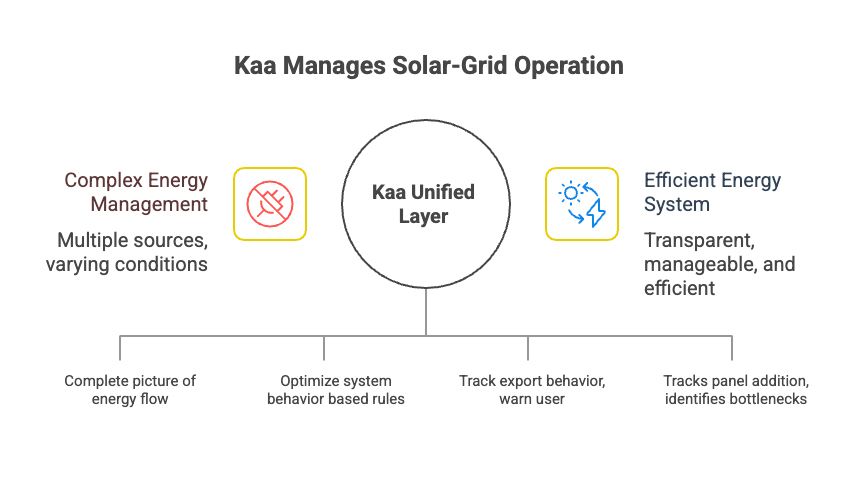
Mixed solar–grid setups offer flexibility but also introduce complexity: multiple energy sources, varying operating conditions, and utility rules governing exports and imports. Kaa provides a unified solar monitoring and control layer that makes these systems easier to manage, more transparent, and more efficient.
Real-time visibility into energy sources
Kaa connects to inverters, meters, gateways, and battery systems to provide a complete picture of how energy flows through the installation. Users can see:
- How much power is being supplied by solar, grid, and battery at any moment
- Import vs. export dynamics on each phase or circuit
- State of charge, consumption curves, and PV generation trends
- Seasonal performance differences and long-term usage patterns
This allows homeowners and installers to understand exactly when and why the grid steps in, how much load solar is covering, and where energy losses occur.
Automated control of energy flows
Because Kaa supports control commands, not just monitoring, it can actively optimize system behavior based on rules and conditions.
Typical control scenarios include:
- Zero-export mode: Preventing solar from feeding back into the grid when regulations or metering restrictions require it
- Load shifting: Turning on flexible loads (pumps, EV chargers, heaters) when solar production is highest
- Battery prioritization: Charging batteries from solar first, then supplementing from the grid only during low-sunlight periods
- Grid import limits: Restricting how much power the system draws during peak-tariff hours
Kaa’s rule engine allows users to set thresholds based on time, battery SOC, voltage levels, tariffs, and inverter readings.
Detecting and preventing metering problems
Incorrectly configured digital meters can misinterpret export as consumption, leading to unexpected charges. Kaa helps avoid this by:
- Tracking real-time export behavior;
- Warning the user if energy is being pushed to the grid when it shouldn’t be;
- Highlighting reverse-flow anomalies that indicate a misconfigured utility meter;
- Logging import/export history for troubleshooting with the utility.
This ensures the system operates safely and that billing reflects actual usage.
Supporting gradual solar expansion
For users who start with a small solar array and add panels over time, Kaa simplifies the growth process:
- Tracks how each added panel or string reduces grid consumption;
- Identifies when the inverter becomes a bottleneck (oversized/undersized);
- Highlights circuits that still rely heavily on grid power;
- Provides data to help size batteries or additional PV modules.
Kaa effectively becomes a performance dashboard that guides long-term upgrades and ensures the solar system evolves efficiently.
You may be interested in: How PV inverters collect, log, and share solar performance data
Conclusion
Solar and grid power can work together smoothly in hybrid and grid-tie systems, offering flexibility, reliability, and the ability to expand solar capacity over time. The behavior of these systems depends on inverter design and proper utility meter configuration. A well-set-up hybrid system can blend solar, battery, and grid power with minimal interruption, ensuring consistent energy availability year-round.
Kaa enhances these capabilities by providing real-time visibility, control automation, error detection, and performance insights. With Kaa, homeowners and installers can prevent unwanted export, reduce grid dependency, and make the most of every kilowatt of solar energy.