
BESS as part of the EV charging infrastructure in the United States
January 23, 2026The rapid expansion of electric vehicles in the United States is reshaping not only transportation but the electrical infrastructure that supports it. EV adoption is accelerating faster than many local grids were designed to handle, and the tension is most visible in fast and ultra-fast charging infrastructure. According to the International Energy Agency, the US had more than 3.5 million electric vehicles on the road by the end of 2024, with EV sales maintaining strong year-over-year growth. In parallel, public charging infrastructure has expanded quickly, driven by federal programs, state incentives, and private investment. Yet this expansion is revealing a structural mismatch between charging demand and grid capabilities.
The core issue is simple but often misunderstood: EV charging is power-intensive, not energy-intensive. A charging site may consume a moderate amount of electricity over a full day, but it can demand extremely high power for short periods. Those short peaks, not total energy consumption, are what stress distribution networks and limit scalability. Battery Energy Storage Systems (BESS) are increasingly emerging as a foundational component of EV charging infrastructure precisely because they address this mismatch at its root.
EV charging demand and US grid constraints
Most US distribution grids were designed around predictable, relatively stable loads such as residential neighborhoods, retail centers, and light commercial facilities. High-power EV charging breaks those assumptions. A single DC fast charger typically draws between 150 and 350 kW, while newer fleet and heavy-duty charging systems can exceed that range. When several vehicles plug in simultaneously, site demand can spike instantly into the megawatt range.
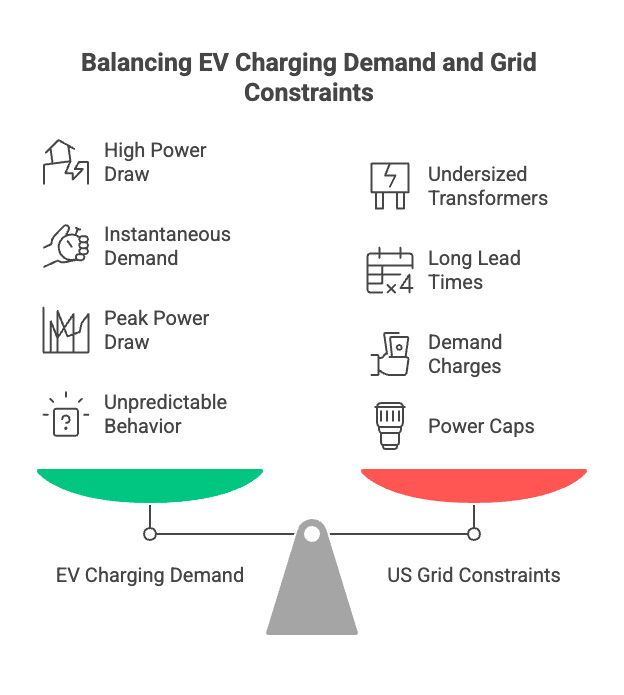
From the grid’s perspective, a fast-charging site behaves less like a conventional commercial customer and more like a small industrial facility that turns on and off unpredictably. This creates a combination of technical and economic constraints that repeatedly surface across the US charging market:
- local transformers and feeders are often undersized for short-duration peak loads;
- grid interconnection upgrades can require long lead times and substantial capital investment;
- commercial electricity tariffs penalize peak power draw through demand charges;
- utilities may impose power caps or phased interconnection approvals for high-load sites.
These constraints increasingly shape where fast-charging sites can be deployed and how much power they can reliably deliver. In many cases, the grid becomes the binding limitation.
Why BESS changes the economics of EV charging
Battery Energy Storage Systems fundamentally change how EV charging sites interact with the grid. Instead of drawing peak power directly from the distribution network, a BESS-enabled site pulls electricity from the grid at a controlled, predictable rate while using the battery to supply short-duration charging peaks. This decoupling of charging power from grid capacity has far-reaching implications. It allows operators to deploy high-power charging in locations that would otherwise require major grid upgrades, while also reducing exposure to demand charges and improving site reliability.
Importantly, the battery does not need to cover the site’s total daily energy consumption. It only needs to be sized for peak power and duration, typically minutes rather than hours. This distinction makes BESS economically viable for charging infrastructure and explains why storage is increasingly treated as infrastructure rather than as an experiment.
Solar PV, BESS, and EV charging in the US context
The United States is particularly well-positioned to combine EV charging with on-site solar generation. According to the US Energy Information Administration, solar accounted for more than half of all new electricity generation capacity added in 2024, and distributed solar continues to expand across commercial and industrial sites. On its own, however, solar cannot reliably support fast EV charging. Solar production is intermittent, while charging demand is highly variable and often peaks outside daylight hours. Without storage, much of the available solar energy remains poorly aligned with when chargers are actually used.
In a solar-plus-storage charging architecture, each component plays a distinct role:
- solar generation reduces total grid energy consumption when available;
- batteries store excess solar output and supply charging peaks later in the day;
- the grid provides balancing, backup, and long-duration energy support.
The value of this configuration lies not in full energy independence but in flexibility. Solar lowers energy costs and emissions, while BESS ensures that power is available precisely when fast charging demand materializes.
Why BESS adoption is accelerating in the US market
The accelerating adoption of Battery Energy Storage Systems in US EV charging infrastructure is driven not only by technical grid constraints, but by a broader shift in how charging projects are planned, financed, and scaled. As charging networks expand nationally, developers and operators are increasingly prioritizing predictability, capital efficiency, and speed to market over purely theoretical peak capacity.
In this context, BESS is no longer treated as a niche optimization tool. Instead, it has become a strategic design element that reduces development risk, improves financial modeling, and enables repeatable site architectures across regions with very different grid conditions. The table below summarizes the core non-technical drivers behind this shift and explains why storage-enabled designs are gaining traction across the US charging market.
Key market drivers accelerating BESS adoption in US EV charging
| Driver | Without BESS | With BESS |
|---|---|---|
| Grid interconnection timelines | Long, uncertain, often dependent on external utility upgrades | More predictable; smaller grid connections can be approved faster |
| Upfront capital allocation | Large investments in grid capacity sized for future peak demand | Phased investment; grid capacity and chargers can scale over time |
| Demand charge exposure | High sensitivity to short peak events | Peaks absorbed by storage, reducing tariff volatility |
| Site viability | Many urban and highway locations constrained by grid limits | Storage unlocks locations that would otherwise be infeasible |
| Project bankability | Cash flows exposed to tariff changes and curtailment risk | More stable operating profiles improve financing terms |
| Real estate flexibility | Requires physical space and permits for grid expansion | Compact storage systems reduce dependence on grid-side construction |
| Deployment speed | Grid upgrades can delay site launch by years | Faster commissioning with minimal grid reinforcement |
| Scalability across regions | Site design must be reworked for each utility territory | Modular architecture adaptable to diverse grid conditions |
| Long-term adaptability | Fixed infrastructure may become obsolete as charging power rises | Storage can be resized or reconfigured as demand evolves |
Why monitoring and control matter
As soon as batteries and solar are added to EV charging infrastructure, the system stops being a simple load and becomes a dynamic energy environment. Power flows shift continuously between the grid, storage, chargers, and on-site generation. In this setup, economic performance depends not only on hardware selection, but on how precisely these flows are monitored and controlled over time. Without centralized visibility, BESS-enabled charging sites often operate suboptimally. Batteries may charge during high-tariff periods, discharge inefficiently, or cycle in ways that accelerate degradation. These issues rarely trigger alarms, yet they directly impact operating costs, asset lifetime, and ROI. Manual oversight or charger-only dashboards are not sufficient once storage becomes part of the architecture.
KaaIoT provides energy management dashboards designed specifically for complex energy systems, enabling operators to monitor EV chargers, BESS, solar generation, and grid interaction within a single, unified view. By correlating real-time telemetry with historical performance data, operators gain the ability to optimize charging strategies, battery dispatch, and peak load management across distributed sites. In practice, this level of monitoring turns BESS from a passive buffer into an actively managed asset. It allows charging networks to move beyond static configurations and operate charging sites as data-driven energy systems that adapt to demand patterns, tariff structures, and long-term asset health.
You may be interested in: Can solar and grid power be used at the same time?
Conclusion
In the United States, the challenge of EV charging is no longer about energy availability. It is about power delivery, grid constraints, and economics. High-power charging pushes distribution infrastructure beyond its original design limits, creating bottlenecks that slow deployment and increase costs. Battery Energy Storage Systems address this challenge directly. By buffering peak demand, reducing grid dependence, and enabling effective solar integration, BESS has become a structural element of scalable EV charging infrastructure. As charging speeds increase and EV adoption continues to grow, sites without storage will face mounting limitations. Those designed with BESS from the outset will be better positioned to scale, remain economically viable, and meet reliability expectations in a grid-constrained future.